Annaprashan
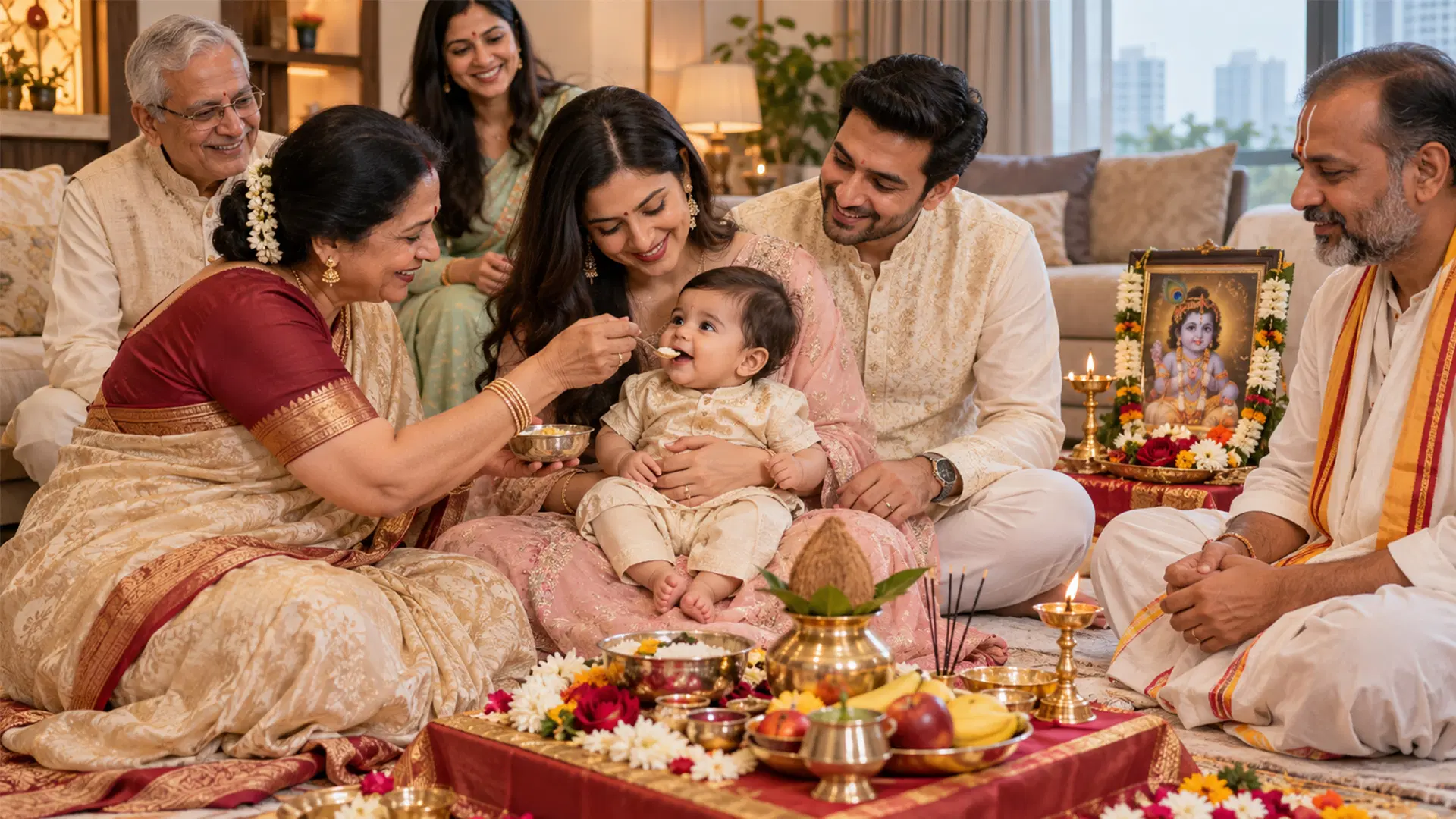
The first-feeding Samskara - the child's formal introduction to solid food through the sacred fire and the feeding of rice cooked in milk, marking the transition from a being sustained entirely by its mother to one who participates in the food of the world.
Overview
What Is This Puja?
Commonly requested for
- ●All first solid-food occasions - one of the most widely observed Samskaras in North Indian families
- ●The sixth-month milestone - usually timed with a family gathering
- ●Combined with the child's Nakshatra birthday (first Janma Nakshatra return, approximately 27 days after the exact birth date)
- ●NRI families visiting India who wish the Samskara performed in the extended family context
- ●The object-choice ceremony - widely documented and shared on social media; families seek the formal puja framing for this
Ritual Flow
Understanding the sequence helps you participate meaningfully rather than merely observe.
Opening sequence
Sankalpa
Father makes the Sankalpa - child's name, Nakshatra Naam (from the Naamkaran), birth date, and the specific intention of the Annaprashan.
Ganapati Puja and Annapurna Avahana
Ganesha worshipped first. Then Annapurna - the goddess of nourishment - formally invited and established. Annapurna is Parvati in her aspect as the inexhaustible provider of food; she is specifically the presiding deity of this ceremony. A brief Shodashopachara for Annapurna.
Charu Preparation and Agni Offering
The Charu - rice cooked in milk with ghee and honey - prepared in a new clay or copper vessel during the ceremony. The purohit offers three Ahutis of Charu into the Havan Kund with the three Annaprashan mantras (Medha, Bala, Ayu).
Samagri Required
Every item has a function - this is a functional manifest, not a shopping list.
Roli (100 gm)
Tilak, sankalp, archan
Moli / Kalawa (2 bundles)
Wrist, kalash, idol tying
Sindoor (50 gm)
Devi puja, suhag, tilak
Abeer (20 gm)
Archan
Gulal — Lal (20 gm)
Archan
Gulal — Peela (20 gm)
Archan
Abhrak (mica) (20 gm)
Kalash, tantra-pratik
Haldi (powder) (50 gm)
Archan, kalash
Kapur (camphor) (20 gm)
Aarti
Dhoop batti (1 packet)
Dhoop deep
Ruii (cotton) (10 gm)
Wick-making
Itra (5 ml)
Deity offering
Peeli sarso (20 gm)
Puja, kalash
Laung (5 gm)
Naivedya, hawan
Elaichi (chhoti) (5 gm)
Naivedya, hawan
Supari (7 pcs)
Sankalp, kalash
Nariyal (whole) (1 pc)
Kalash sthapana
Panchmewa (50 gm)
Naivedya
Shahad (50 gm shishi)
Panchamrit, naivedya
Sarvaushadhi (10 gm)
Kalash
Janeu / Yajnopavita (5 pcs)
Deity, yajman, sankalp
Frequently Asked Questions
You Might Also Like

Vivah Puja
The wedding itself, conducted as the parampara wrote it. Agni as witness, the gathbandhan tied, the seven steps taken: a lineage-trained pandit for the most important vidhi of household life.

Roka / Sagai Puja
The first yes, given its sacred witness. Two families, two gotras, one sankalp: the alliance honoured before the rings are exchanged.

Ayushya Shanti Puja
The birthday given back its sacred shape. The janma tithi honoured, the Ayushya mantras recited over one beloved head, the year ahead formally blessed.