Kali Puja
The Mother in her most powerful form invoked at home - 11 paath of the Kali Stuti, the household placed under Maa Kali's fierce protection.
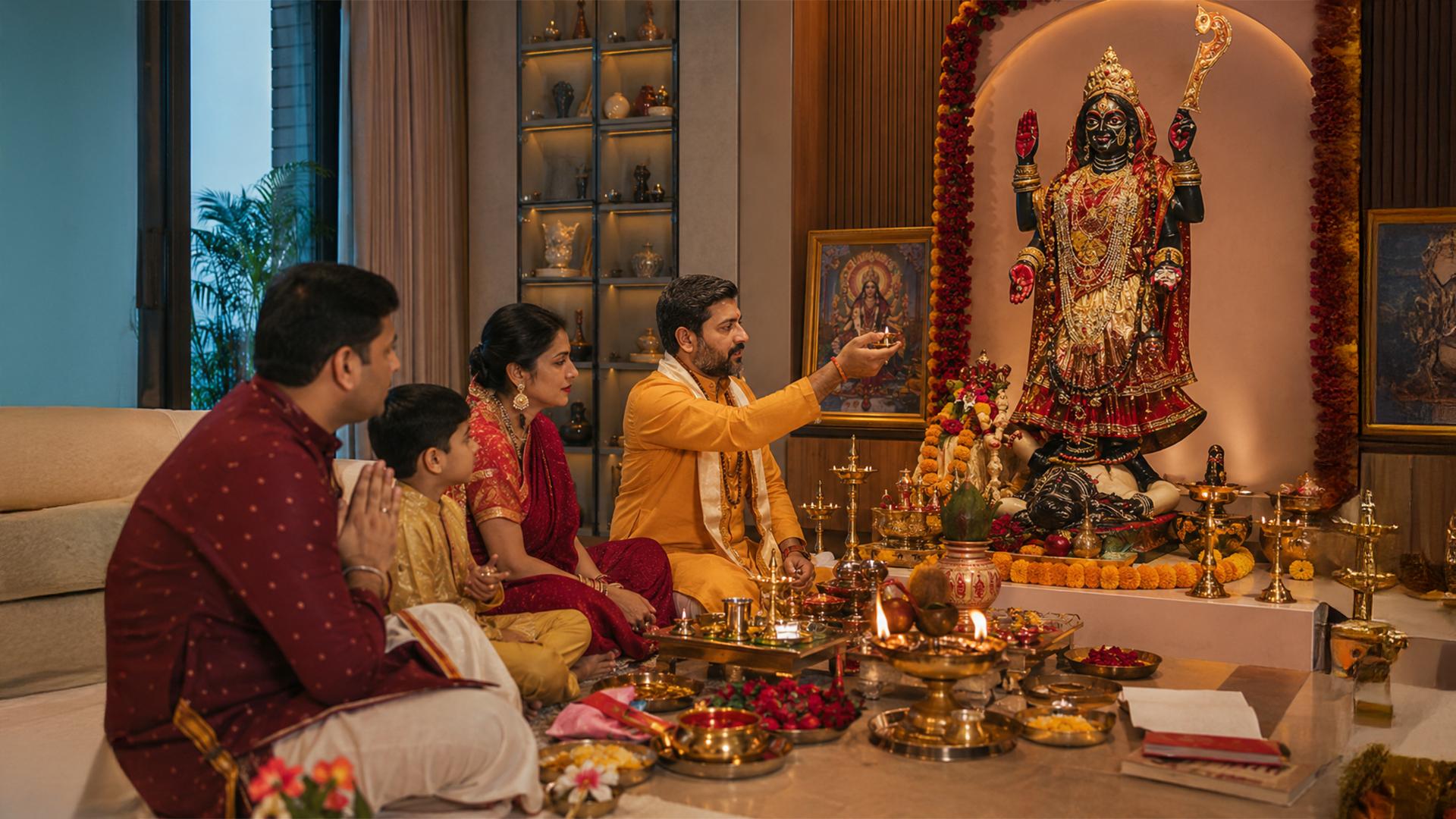
Overview
What Is This Puja?
Commonly requested for
- ●On Kali Chaudas (Narak Chaturdashi, the night before Diwali)
- ●On Amavasya tithis as a recurring observance
- ●During Chaitra and Sharad Navratri, on the day of Kalaratri (seventh Navratri form)
- ●For families navigating significant fear, threat, or persistent negative experiences
- ●After significant family crises as a protective shanti
- ●When an astrologer has identified the need for a Kali-focused remedial puja
Ritual Flow
Understanding the sequence helps you participate meaningfully rather than merely observe.
Opening sequence
Pavitrikaran & Achaman
The family's primary member is purified with sacred water and three sips of achaman before the rite.
Tilak & Rakshabandhan
Tilak is applied and protective mauli tied on the right wrist of the yajman.
Dik Rakshan
Yellow mustard is offered to the four directions to secure the puja space.
Samagri Required
Every item has a function - this is a functional manifest, not a shopping list.
Roli (100 gm)
Tilak, sankalp, archan
Moli / Kalawa (2 bundles (gulli))
Wrist, kalash, idol tying
Sindoor (50 gm)
Devi puja, suhag, tilak
Abeer (20 gm)
Archan
Gulal - Lal (20 gm)
Archan
Gulal - Peela (20 gm)
Archan
Abhrak (mica) (20 gm)
Kalash, tantra-pratik
Haldi (powder) (50 gm)
Archan, kalash
Kapur (camphor) (20 gm)
Aarti
Dhoop batti (1 packet)
Dhoop deep
Ruii (cotton) (10 gm)
Wick-making
Itra (5 ml (1 shishi))
Deity offering
Peeli sarso (20 gm)
Puja, kalash
Laung (5 gm)
Naivedya, hawan
Elaichi (chhoti) (5 gm)
Naivedya, hawan
Supari (7 pcs)
Sankalp, kalash
Nariyal (whole) (1 pc)
Kalash sthapana
Panchmewa (50 gm)
Naivedya
Shahad (50 gm shishi)
Panchamrit, naivedya
Sarvaushadhi (10 gm)
Kalash
Janeu / Yajnopavita (5 pcs)
Deity, yajman, sankalp
Important Note
The puja includes 11 paath of the Kali Stuti as the central recitation. Where the puja is performed on Kali Chaudas, the Vishesh Deep Jalana of 14 deepaks across the home's rooms is integrated as part of the rite at the family's discretion. For Ghar Par Puja, the family arranges the Kali ji murti, the red cloth and shringar items, the khichdi and kheer ingredients, and the hawan kund (where the Hawan add-on is opted in).
Frequently Asked Questions
You Might Also Like

Pradosh Puja
Shiva and Parvati honoured in the twilight kaal - the household's evening puja extended into a full Pradosh observance with bilva patra and the prescribed shringar.

Shiva Puja
Mahadev honoured in the household seat - Shiva ji invoked with full vidhi-vidhan, bilva patra offered, the family placed under his grace.

Hanuman Puja
Hanuman ji invoked in the home - 11 paath of the Hanuman Chalisa, the family placed under his protection, courage and devotion drawn from his grace.