Roka / Sagai Puja
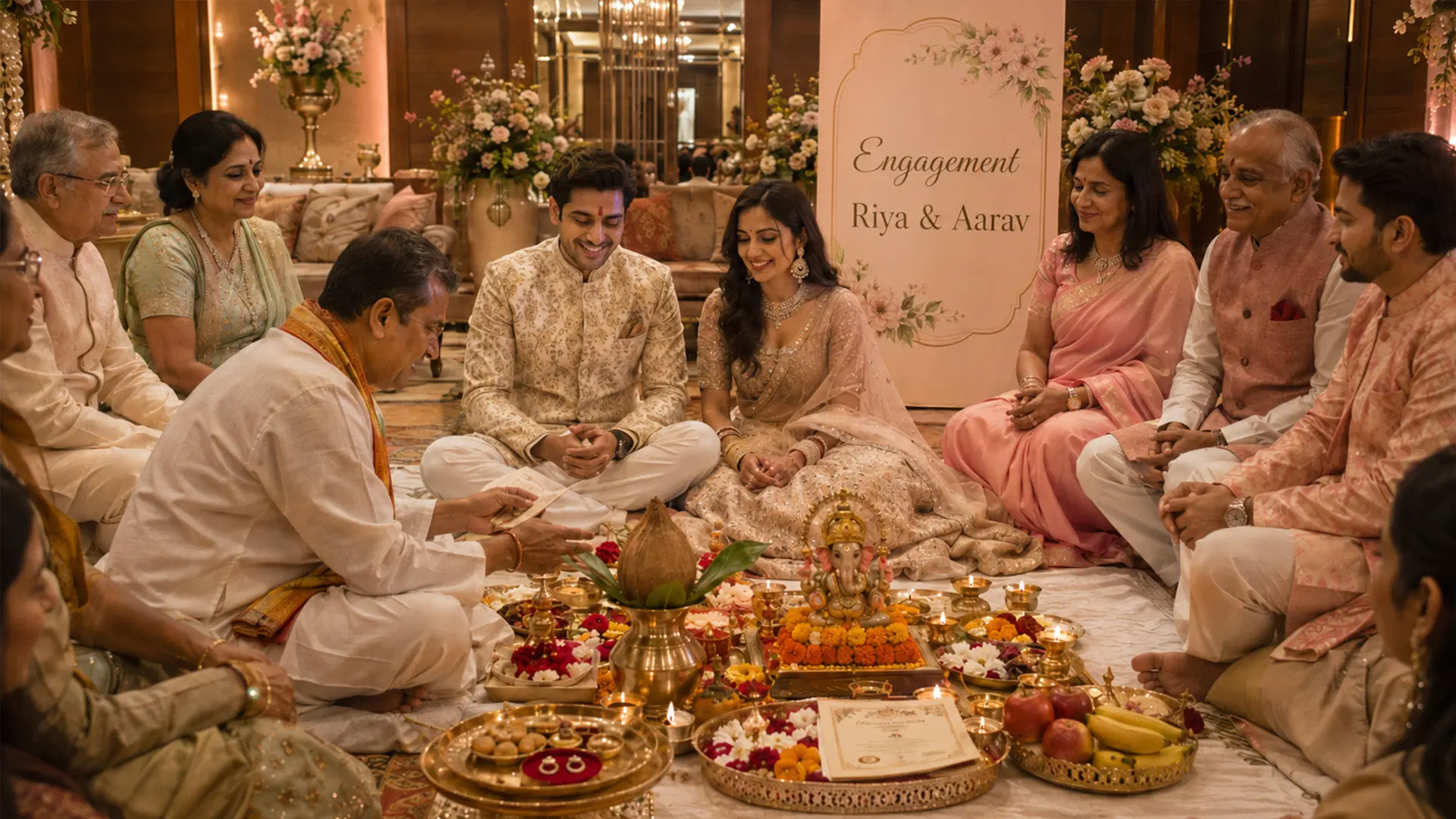
The first yes, given its sacred witness. Two families, two gotras, one sankalp: the alliance honoured before the rings are exchanged.
Overview
What Is This Puja?
Commonly requested for
- ●The roka ceremony, where the two families formally halt all other searching
- ●The sagai or engagement, with the ring exchange on the auspicious mantra
- ●Combined roka and sagai gatherings held as one function
- ●Tilak ceremonies in traditions where the groom's tilak marks the alliance
- ●Intimate home ceremonies as well as venue functions
- ●Alliances where families wish both Kul Devatas formally invoked at the outset
Ritual Flow
Understanding the sequence helps you participate meaningfully rather than merely observe.
Opening sequence
Pavitrikaran & Achaman
The family's primary member is purified with sacred water and three sips of achaman before the rite.
Dik Rakshan
Yellow mustard is offered to the four directions to secure the puja space.
Swastivachan & Mangal Mantra
Mangal mantras are chanted to invoke auspiciousness before the formal rite begins.
Samagri Required
Every item has a function - this is a functional manifest, not a shopping list.
Roli (100 gm)
Tilak, sankalp, archan
Moli / Kalawa (2 bundles (gulli))
Wrist, kalash, idol tying
Sindoor (50 gm)
Devi puja, suhag, tilak
Abeer (20 gm)
Archan
Gulal (Lal) (20 gm)
Archan
Gulal (Peela) (20 gm)
Archan
Abhrak (mica) (20 gm)
Kalash, tantra-pratik
Haldi (powder) (50 gm)
Archan, kalash
Kapur (camphor) (20 gm)
Aarti
Dhoop batti (1 packet)
Dhoop deep
Ruii (cotton) (10 gm)
Wick-making
Itra (5 ml (1 shishi))
Deity offering
Peeli sarso (20 gm)
Puja, kalash
Laung (5 gm)
Naivedya, hawan
Elaichi (chhoti) (5 gm)
Naivedya, hawan
Supari (7 pcs)
Sankalp, kalash
Nariyal (whole) (1 pc)
Kalash sthapana
Panchmewa (50 gm)
Naivedya
Shahad (50 gm shishi)
Panchamrit, naivedya
Sarvaushadhi (10 gm)
Kalash
Janeu / Yajnopavita (5 pcs)
Deity, yajman, sankalp
Frequently Asked Questions
You Might Also Like

Vivah Puja
The wedding itself, conducted as the parampara wrote it. Agni as witness, the gathbandhan tied, the seven steps taken: a lineage-trained pandit for the most important vidhi of household life.

Ayushya Shanti Puja
The birthday given back its sacred shape. The janma tithi honoured, the Ayushya mantras recited over one beloved head, the year ahead formally blessed.

Tulsi Vivah Puja
The sacred marriage of Tulsi to Vishnu ji - the household tulsi adorned as the bride, Shaligram as the groom, the family witnesses the divine vivah.