Home/Pooja At Temple/Saraswati Puja
Wealth & SuccessPerformed by: 1 PanditDuration: 2–4 hours

Saraswati Puja

The worship of Vak Devi - the goddess of speech, learning, and the arts performed on Vasant Panchami and before examinations, invoking the divine intelligence that transforms raw capability into accomplished knowledge.

Saraswati Puja

Overview

What Is This Puja?

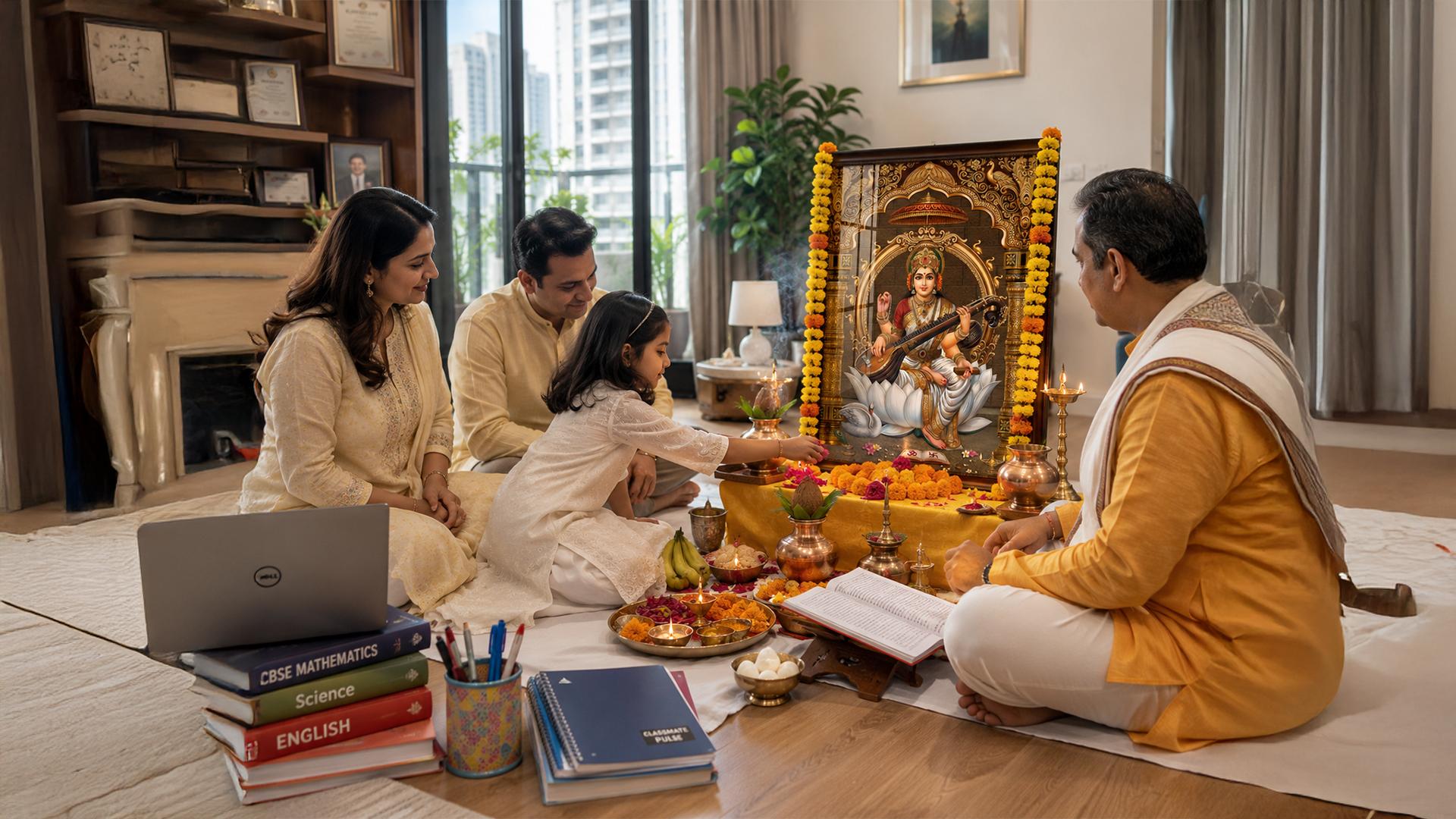
The Saraswati Sukta of the Rigveda does not address a goddess of books and veenas in the way popular iconography presents her. It addresses a force - ambitame, naditame, devitame - the best of mothers, the best of rivers, the best of goddesses. The three epithets are instructive: Saraswati nourishes (like a mother), she flows without obstruction (like a river), and she is the divine itself in its most elevated form. These three qualities describe not a patron deity of students but the fundamental nature of genuine intelligence. What Saraswati bestows - Vak, Vidya, Viveka - is not just the ability to pass examinations. Vak is the power of speech in its deepest sense: the capacity to articulate truth. Vidya is not mere information but the organised understanding that transforms information into wisdom. Viveka is discriminative intelligence, the ability to distinguish the real from the unreal, the essential from the peripheral. These are not separate gifts. They are three aspects of the same faculty that the goddess embodies. In the North Indian tradition, the Saraswati Puja's most visible expression is the Vasant Panchami ceremony. Books, writing instruments, musical instruments, and tools of any craft are placed before the goddess's image, acknowledging that the intelligence infused in every discipline of human knowledge is the same Devi in different forms. The student's textbook and the musician's instrument are equally her domain.
SiddhiStar Note
"I have noticed over the years that students come to Saraswati Puja asking for marks, and this is understandable. But the correct asking is different. The Saraswati Stotra says: Yaa kundendu tushara hara dhavala - pure as the kunda flower, the moon, the snow, the white garland. Purity here means clarity of mind: the absence of the internal clutter that prevents genuine understanding. The puja asks for that clarity first. The marks are a consequence of the clarity, not the direct request."
Primary Deities
Saraswati (Vak Devi, Sharada) • Ganesha (first) • Gauri • Varun Dev (via Kalash)

Commonly requested for

  • Vasant Panchami - the primary annual occasion; widely performed across North Indian households and schools
  • Before board examinations (Class 10, Class 12) and competitive entrance examinations (JEE, NEET, UPSC, CAT)
  • Before a child begins formal education - the Vidyarambham tradition
  • For musicians, dancers, and artists - placing instruments before Saraswati and receiving them back as consecrated
  • Writers, teachers, lawyers, and professionals whose work depends on the quality of their speech and articulation
  • For children experiencing learning difficulties - seeking Saraswati's specific blessing for cognitive clarity

Where Does This Puja Come From?

Primary Source
Rigveda 6.61 - Saraswati Sukta (seven mantras addressed to the river-goddess Saraswati as the embodiment of divine speech and flow of knowledge) · Rigveda 1.3.10–12 - Saraswati invoked as the nourisher of thought
Supporting Texts
Devi Bhagavata Purana - Saraswati as one of the three primary Devis (with Lakshmi and Parvati) · Brahma Vaivarta Purana - Saraswati's nature and the Saraswati Stotra · Saraswati Rahasya Upanishad - the philosophical basis for Vak worship

Ritual Flow

Understanding the sequence helps you participate meaningfully rather than merely observe.

1

Sankalpa and Samagri Arrangement

Householder declares intent with gotra, nakshatra, and specific purpose - examination, Vasant Panchami, academic year, or professional beginning. Books, instruments, and implements of learning arranged neatly before the puja area. These will be formally placed before the goddess during the ceremony.

2

Kalash Sthapana and Ganapati Puja

Kalash established with Varun mantras. Ganesha worshipped first in Saraswati Puja specifically, the Ganapati Atharvashirsha's identification of Ganesha with the primordial word (Tvam eva pratyaksham tattvam asi) is emphasised, connecting Ganesha's domain of intelligence with Saraswati's domain of speech.

3

Saraswati Avahana and Sthapana

Saraswati invited into her murti or image - white-clad, veena-holding, seated on a white lotus. The Avahana mantra from the Devi Bhagavata tradition recited. A white cloth spread as the asana. White flowers - white chrysanthemum, white lotus, or white marigold, placed as the first offering.

4

Shodashopachara - with Saraswati-Specific Offerings

Sixteen offerings performed. Saraswati's specific offering set in the North Indian tradition: white flowers, white cloth, white rice (Shweta Akshata), white sandalwood paste, and Durva grass offered. Yellow is her festival colour on Vasant Panchami - yellow flowers and yellow sweets also offered.

5

Saraswati Sukta - Rigvedic Recitation

The Saraswati Sukta (Rigveda 6.61, seven mantras) recited by the purohit with individual flower offerings at each mantra. This is the Vedic root of the ceremony and connects the household puja to the oldest stratum of the tradition.

6

Saraswati Vandana and Stotra

The Saraswati Vandana (Ya Kundendu Tushara Hara Dhavala) recited the most widely known Saraswati stotra in North India. Followed by the Saraswati Ashtottara (108 names) with white flower or white akshata offering at each name.

7

Pustak Puja - Placing Books before Devi

All books, notebooks, writing instruments, and implements of the seeker's discipline formally placed before Saraswati's murti. The Vidya Pradayini mantra recited. These remain overnight if possible and are received back the next morning as consecrated - the Devi's blessing infused into the instruments of one's work.

8

Aarti and Prasad

Aarti with a five-wick lamp. Prasad - yellow rice (on Vasant Panchami), sweets, and fruit will be distributed. The writing instruments or a pen received by the seeker from the purohit as prasad carries particular significance.

Understanding the sequence helps you participate meaningfully rather than merely observe.

Samagri Required

Every item has a function — this is a functional manifest, not a shopping list.

Saraswati Murti

White-clad, veena-holding; ceramic or metal form

White Flowers

Saraswati's primary flower; chrysanthemum, white lotus, white marigold

Yellow Flowers

Vasant Panchami specific - marigold, mustard; spring's colour

White Cloth (asana)

Saraswati's colour; spread as murti asana

White Sandalwood

Gandha offering; Saraswati's cooling, purifying paste

Shweta Akshata

White rice for offerings; Saraswati's akshata

Durva Grass

Offered to Ganesha and as a connecting offering within the ceremony

Yellow Sweets

Vasant Panchami prasad: yellow rice, boondi ladoo

Kalash (Copper)

Ceremony anchor; Varun Dev's seat

Mango Leaves (5)

Kalash mouth; spring and new-beginning symbol

Books and Instruments

Placed before the murti during Pustak Puja; received back as consecrated

Pen / Stylus

A pen placed before Devi and received back as prasad

Camphor

Aarti

Panchamrit

Abhisheka sequence for Saraswati

SiddhiStar Samagri Policy
All Standard and Premium bookings include the complete samagri kit. Our purohit brings everything, tradition-matched and verified before travel. No sourcing required from your side.

Frequently Asked Questions

Our child has an examination in two weeks. Should we do the full Saraswati Puja or a shorter version?
For a pre-examination puja with a two-week window, the Standard version is appropriate - Shodashopachara, Saraswati Sukta, Saraswati Vandana, and Ashtottara. The abbreviated version (just Aarti and Stotra) is a devotional gesture, not a puja. The full ceremony with Sankalpa specifically naming the examination and the desired outcome is the appropriate form.
We want to place our child's Class 10 board examination admit card before Saraswati. Is that appropriate?
Can Saraswati Puja and Ganesh Puja be combined for examinations?
We are a family of musicians. Can instruments be consecrated through this puja?
Pooja Starting From
Starting from ₹2,500
Final price depends on pandit selection
April 2026
Su
Mo
Tu
We
Th
Fr
Sa
Lineage-Verified pandits
4.9/5 average rating across all bookings
₹2,500per pandit