Satyanarayan Puja
The family gathers, the katha is heard, prasad is shared - a timeless household observance brought home with the same warmth as Dadi's house.
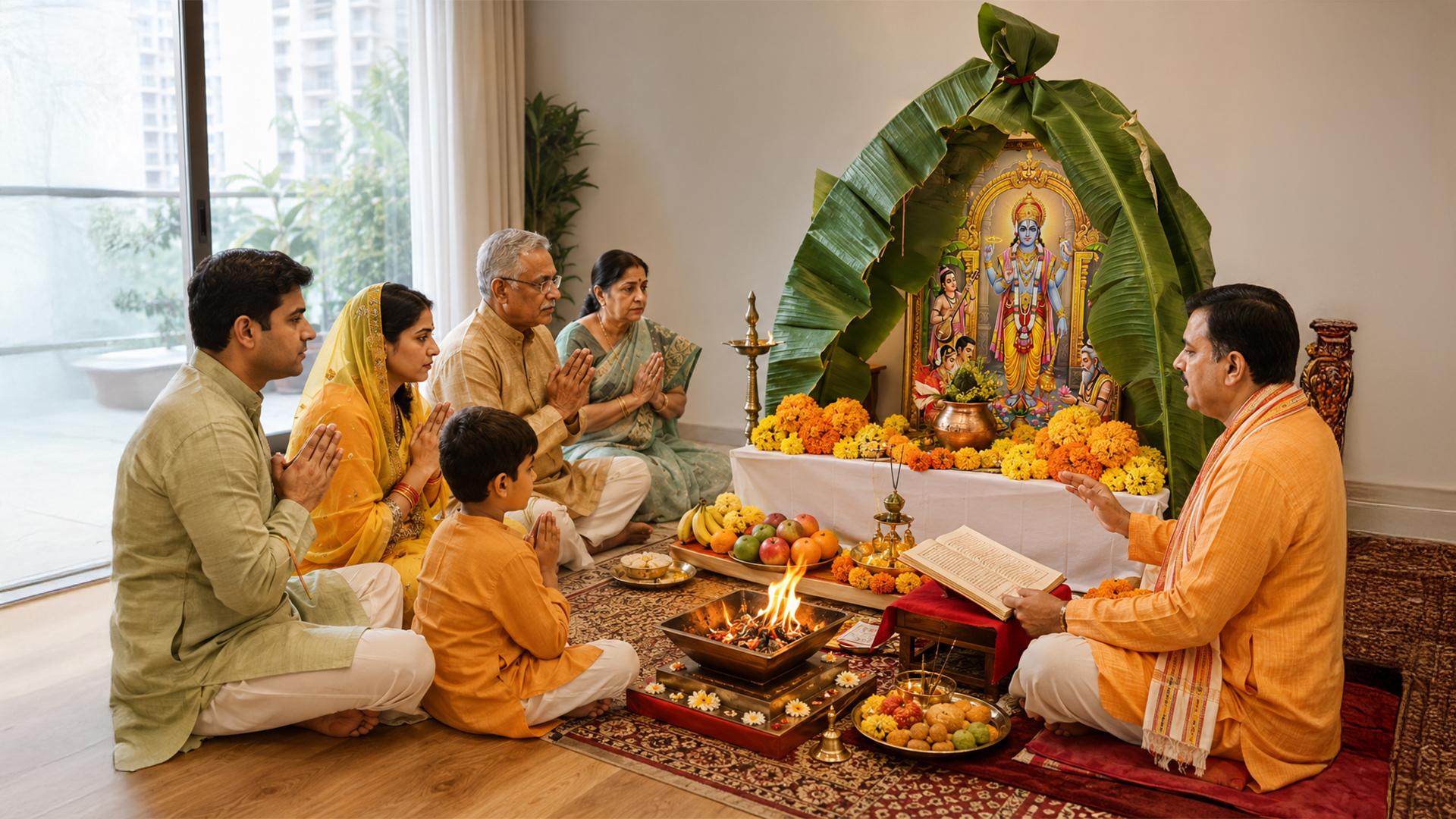
Overview
What Is This Puja?
Commonly requested for
- ●On the fulfilment of a long-held family vow or wish
- ●On significant household occasions - birthdays, anniversaries, name-day, return from a long journey
- ●Before or after major life transitions - marriage, childbirth, new business
- ●Families who perform Satyanarayan vrat on every Purnima as a recurring household observance
- ●After recovery from significant illness in the family
- ●When the household feels the need to consecrate gratitude through a formal rite
Ritual Flow
Understanding the sequence helps you participate meaningfully rather than merely observe.
Opening sequence
Pavitrikaran & Achaman
The family's primary member is purified with sacred water and three sips of achaman before the rite begins.
Tilak & Rakshabandhan
Tilak is applied to the forehead and protective mauli tied on the right wrist of the yajman.
Dik Rakshan
Yellow mustard is offered to the four directions to secure the puja space.
Samagri Required
Every item has a function - this is a functional manifest, not a shopping list.
Roli (100 gm)
Tilak, sankalp, archan
Moli / Kalawa (2 bundles (gulli))
Wrist, kalash, idol tying
Sindoor (50 gm)
Devi puja, suhag, tilak
Abeer (20 gm)
Archan
Gulal - Lal (20 gm)
Archan
Gulal - Peela (20 gm)
Archan
Abhrak (mica) (20 gm)
Kalash, tantra-pratik
Haldi (powder) (50 gm)
Archan, kalash
Kapur (camphor) (20 gm)
Aarti
Dhoop batti (1 packet)
Dhoop deep
Ruii (cotton) (10 gm)
Wick-making
Itra (5 ml (1 shishi))
Deity offering
Peeli sarso (20 gm)
Puja, kalash
Laung (5 gm)
Naivedya, hawan
Elaichi (chhoti) (5 gm)
Naivedya, hawan
Supari (7 pcs)
Sankalp, kalash
Nariyal (whole) (1 pc)
Kalash sthapana
Panchmewa (50 gm)
Naivedya
Shahad (50 gm shishi)
Panchamrit, naivedya
Sarvaushadhi (10 gm)
Kalash
Janeu / Yajnopavita (5 pcs)
Deity, yajman, sankalp
Frequently Asked Questions
You Might Also Like

Radha Krishna Puja
The eternal divine couple invited home - Radha-Krishna honoured together as the parampara's archetype of bhakti, devotion, and divine love.

Ram Darbar Puja
The Maryada Purushottam and his court invited home - Ram, Sita, Lakshman and Hanuman honoured together as the household's ideal of dharma, devotion, brotherhood, service.

Mahalakshmi Puja
The elevated observance of the Mother of abundance. Twenty one paath of the Sri Sukta, the fuller shringar, the household's most complete invitation to Lakshmi ji.