Family & MarriagePerformed by: 1 PanditDuration: 2–3 hours
Tulsi Vivah Puja
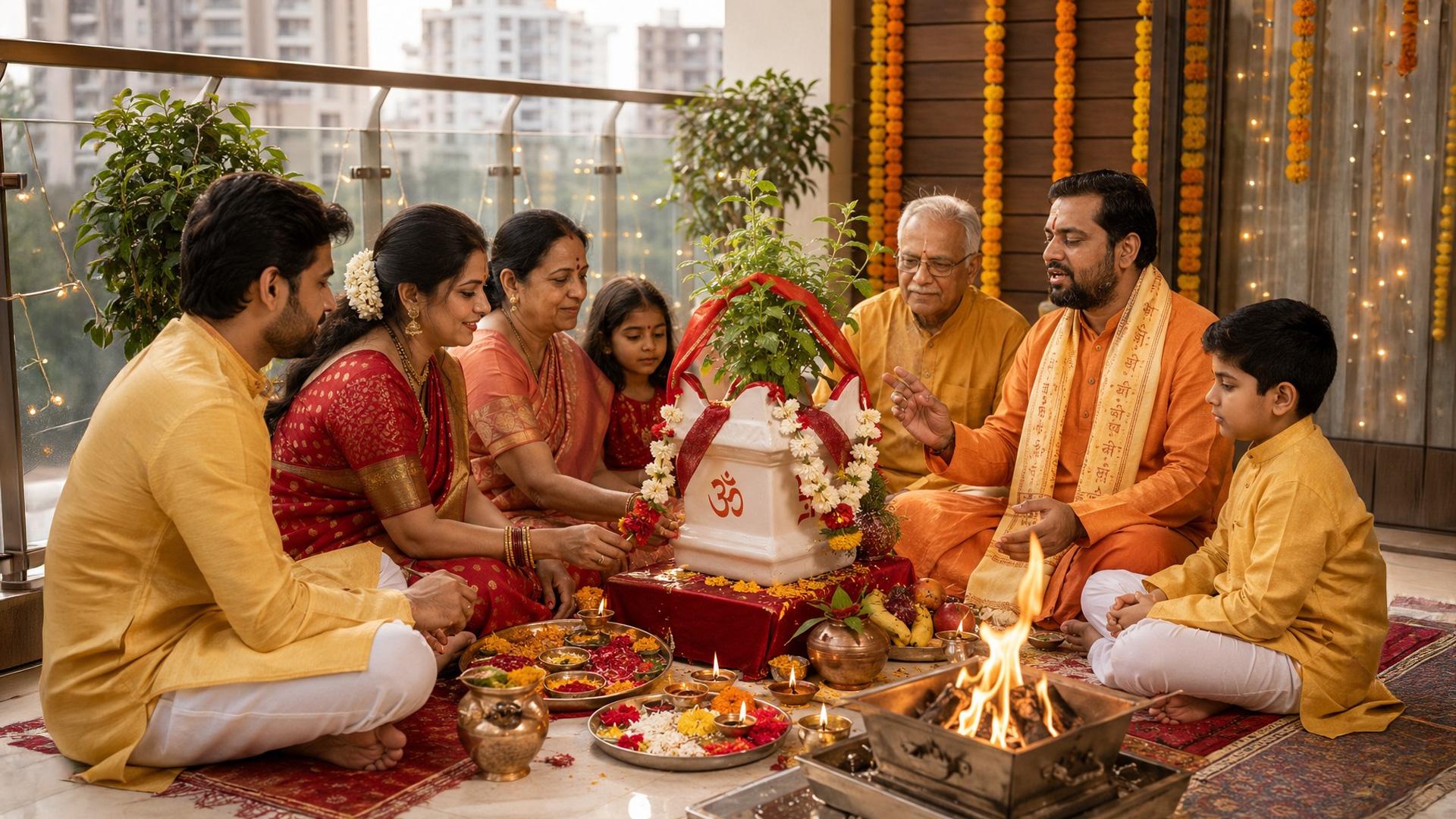
The sacred marriage of Tulsi to Vishnu ji - the household tulsi adorned as the bride, Shaligram as the groom, the family witnesses the divine vivah.
Overview
What Is This Puja?
Tulsi Vivah is one of the most beloved household observances in the North Indian Vaishnava parampara - the ceremonial marriage of the sacred Tulsi plant (regarded as a form of Lakshmi ji) to Shaligram (a sacred stone embodying Vishnu ji). Drawn from the Padma Purana and the Skanda Purana, the rite marks the formal end of the four-month Chaturmas season and the resumption of marriage-season observances for the household.
Most widely performed during Karthik Shukla Ekadashi to Karthik Purnima, the puja can also be booked any time of year by families seeking to perform the rite separately. The ritual moves through purification, sankalp, invocation of Ganesh ji, the formal shringar of the household tulsi as the bride, the placing of the Shaligram as the groom, the recitation of vivah mantras, the symbolic seven pheras, and the offering of the prescribed bhog. At SiddhiStar, the puja is performed at home, or as an Online Puja with the pandit performing live from Narwar Dham while the family joins live from home. The base puja takes approximately two hours, with Hawan offered as an optional 30-minute add-on at the time of booking.
SiddhiStar Note
“In every traditional North Indian household with a tulsi at the threshold, the Tulsi Vivah is one of the most domestically intimate rites of the year. The tulsi is not merely a plant, she is the household's silent witness to every prayer, every aarti, every family gathering on the chowk. To dress her as a bride and witness her marriage to Vishnu ji is to formally acknowledge the divinity of what the family has lived alongside for years. The rite is performed with the same care, sweets, and music as a household wedding.”
Primary Deities
Tulsi Devi (Vrinda - the sacred basil plant as a divine being, primary) • Vishnu / Shaligram (as the bridegroom) • Ganesha (first) • Varun Dev
Commonly requested for
●During Karthik Shukla Ekadashi (Devuthani / Devotthana Ekadashi), the most observed annual day
●On Karthik Purnima as a closing observance
●Throughout the Karthik Shukla Ekadashi to Karthik Purnima window
●As a separate household observance any time of year
●By families with a household tulsi seeking to formally consecrate the plant
●On family wedding anniversaries as a household blessing
Ritual Flow
Understanding the sequence helps you participate meaningfully rather than merely observe.
Opening sequence
1
Pavitrikaran & Achaman
The family's primary member is purified with sacred water and three sips of achaman before the rite.
2
Tilak & Rakshabandhan
Tilak is applied and protective mauli tied on the right wrist of the yajman.
3
Dik Rakshan
Yellow mustard is offered to the four directions to secure the puja space.
Understanding the sequence helps you participate meaningfully rather than merely observe. The Vivah Mantra Path and the symbolic Saptapadi are the central elements unique to this rite.
Samagri Required
Every item has a function - this is a functional manifest, not a shopping list.
Roli (100 gm)
Tilak, sankalp, archan
Moli / Kalawa (2 bundles (gulli))
Wrist, kalash, idol tying
Sindoor (50 gm)
Devi puja, suhag, tilak
Abeer (20 gm)
Archan
Gulal - Lal (20 gm)
Archan
Gulal - Peela (20 gm)
Archan
Abhrak (mica) (20 gm)
Kalash, tantra-pratik
Haldi (powder) (50 gm)
Archan, kalash
Kapur (camphor) (20 gm)
Aarti
Dhoop batti (1 packet)
Dhoop deep
Ruii (cotton) (10 gm)
Wick-making
Itra (5 ml (1 shishi))
Deity offering
Peeli sarso (20 gm)
Puja, kalash
Laung (5 gm)
Naivedya, hawan
Elaichi (chhoti) (5 gm)
Naivedya, hawan
Supari (7 pcs)
Sankalp, kalash
Nariyal (whole) (1 pc)
Kalash sthapana
Panchmewa (50 gm)
Naivedya
Shahad (50 gm shishi)
Panchamrit, naivedya
Sarvaushadhi (10 gm)
Kalash
Janeu / Yajnopavita (5 pcs)
Deity, yajman, sankalp
SiddhiStar Samagri Policy
The SiddhiStar Anushthan Samagri required for the puja is included in the puja price. The family may choose to receive the samagri at home before the puja date, or arrange the required items themselves from a local kirana store or home delivery app. Either option is honoured equally. The Anushthan Samagri is provided for convenience and standardisation, and is not a separate charge or a ritual necessity.
Hawan Samagri is separate from the Anushthan Samagri and is available as an optional add-on at an additional charge. If the family opts for a Hawan as part of the puja, the applicable Hawan Samagri will be included and charged separately.