Home/Pooja At Temple/Ganesh Puja
Household DeityPerformed by: 1 PanditDuration: 2–4 hours

Ganesh Puja

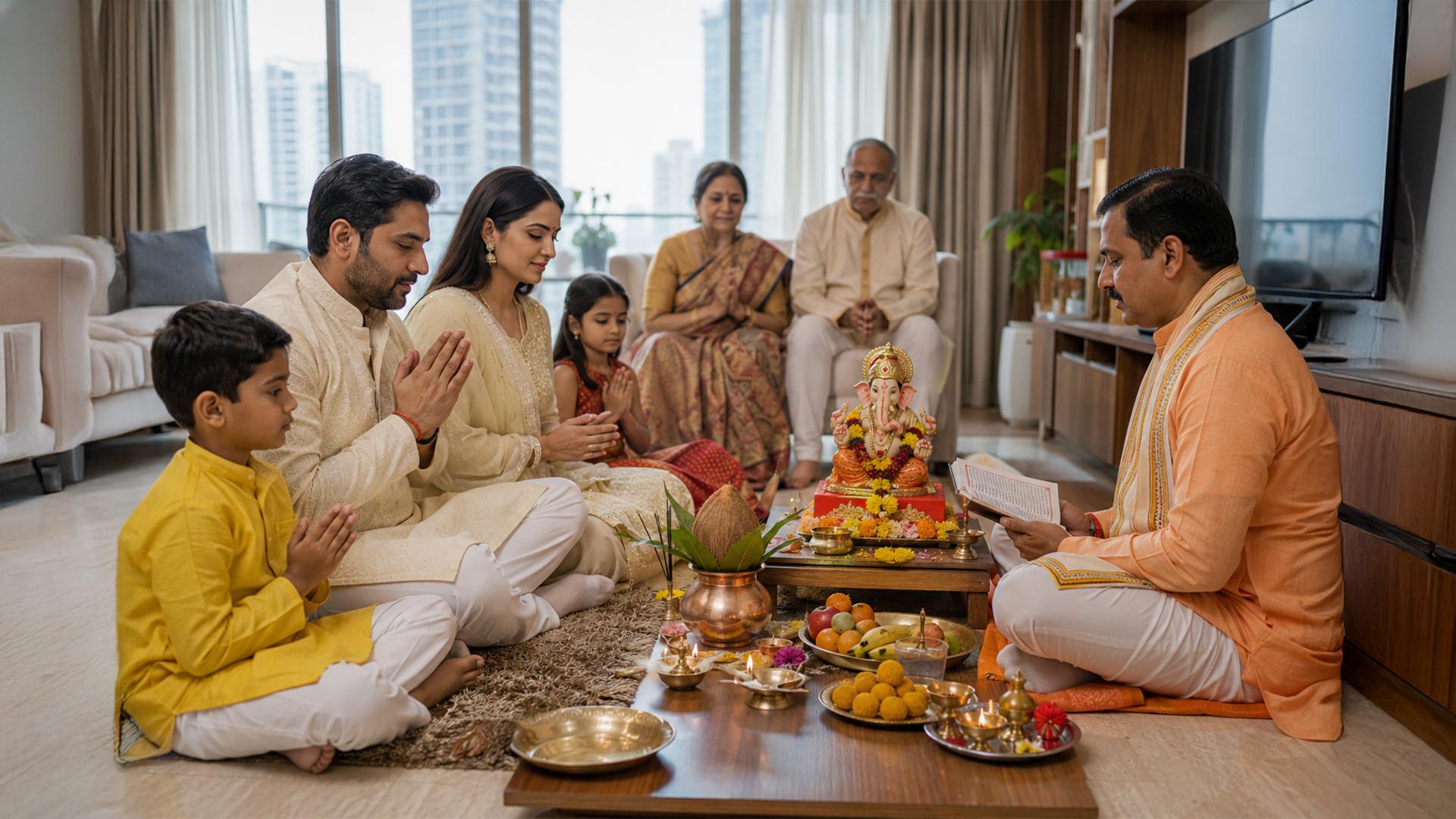
The invocation and worship of Vighnaharta in his complete householder form - performed before any undertaking, on Chaturthi tithis, and as a standalone puja for obstacle removal and auspicious beginning.

SiddhiStar

Overview

What Is This Puja?

Every Vedic ritual begins with Ganesha. Every ceremony, every Homa, every Samskara - the first mantra chanted, the first deity invoked, is Vighnaharta. This is not convention; it is prescribed in the Paraskara Grihyasutra as a rule of ritual procedure. The Ganesh Puja as a standalone ceremony is the complete elaboration of this preliminary worship into its own full event - sixteen offerings, the recitation of the Ganapati Atharvashirsha, and the formal seeking of Ganesha's blessing for a specific intention. The Ganapati Atharvashirsha opens with the declaration: Tvam eva pratyaksham tattvam asi - You alone are the direct-perceptible reality. This positions Ganesha not merely as an obstacle-remover for worldly purposes, but as the Brahman itself accessible to the householder through form-worship. The obstacle Ganesha removes is not only the external obstacle on the path - it is the internal obstruction of ajna (non-wisdom) that clouds the seeker's perception. In the North Indian Smartha tradition, the Ganesh Puja follows a specific sequence from Avahana (invitation) through Visarjana (farewell) with sixteen prescribed offerings at each step. The puja is performed on Chaturthi tithis (the fourth day of each lunar fortnight), on Wednesdays (Budha-var, associated with Ganesha in the North Indian tradition), and before any significant new undertaking.
SiddhiStar Note
"There is a common misunderstanding that the Ganesh Puja performed before another ceremony - say, before a Griha Pravesh - is sufficient. It is not. That is a five-minute preliminary invocation. A full standalone Ganesh Puja, with Sankalpa, Shodashopachara, Atharvashirsha, and Ashtottara, is a different category of worship entirely. When a family comes to me saying they have been doing Ganesh Puja for years but not seeing results, the first question I ask is: are you doing the full vidhi, or onl
Primary Deities
Ganesha (Vighnaharta, Prathamapujya) • Varun Dev (via Kalash) • Riddhi-Siddhi (invoked in full Shodashopachara)

Commonly requested for

  • Before starting a new business, shop, or professional practice
  • Before examinations - competitive exams, board exams, and entrance tests
  • Ganesh Chaturthi (Bhadrapada Shukla Chaturthi) - the annual festival puja
  • Weekly Chaturthi observance for households that maintain this vrat
  • Before a child's first day of school or formal education
  • Establishing a Ganesha idol as the primary Griha Devata in a new home
  • Seeking resolution of a long-standing obstacle - legal dispute, health issue, blocked career progress

Where Does This Puja Come From?

Primary Source
Ganapati Atharvashirsha (Ganapati Upanishad) - the foundational text for Ganesha worship in the Smartha tradition; recited in full during the puja
Supporting Texts
Ganesha Purana (Krida Khanda, Ch. 2) · Mudgala Purana - describes Ganesha's nature, forms, and the complete vidhi for his upasana
Vedic Sanction
Rigveda 2.23.1 - Ganapati Sukta: the oldest Vedic reference to Ganesha as Brahmanaspati, lord of the Brahma (the sacred word) · Yajurveda - Gananam tva mantras

Ritual Flow

Understanding the sequence helps you participate meaningfully rather than merely observe.

1

Sankalpa

Householder declares intent with gotra, nakshatra, and the specific purpose for which Ganesha's blessing is sought. In the Smartha tradition, Ganesha is not worshipped in the abstract - there is always a stated intention that the puja serves.

2

Kalash Sthapana

A copper kalash filled with water, mango leaves, and a coconut is established as the seat of Varun Dev and the energetic anchor of the ceremony. Panchamrit (milk, curd, honey, ghee, sugar) prepared for abhisheka.

3

Ganapati Avahana - Inviting the Deity

Ganesha formally invited into the murti or image with Avahana mantras. In the Smartha tradition, the deity is understood to be genuinely present in the form for the duration of the puja - not merely symbolically represented. This step establishes that presence.

4

Shodashopachara - Sixteen Offerings

Sixteen prescribed offerings made in sequence: Asana (seat), Padya (water for feet), Arghya (water for hands), Achamana (sipping water), Snana (bath), Vastra (cloth), Yajnopavita (sacred thread), Gandha (sandalwood paste), Pushpa (flowers), Dhupa (incense), Dipa (lamp), Naivedya (food), Tamboola (betel), Dakshina (offering), Mangala Aarti, Pradakshina.

5

Ganapati Atharvashirsha

The complete Ganapati Atharvashirsha (Ganapati Upanishad) recited once or three times depending on the occasion. This is the single most important text in Ganesha upasana - it establishes the philosophical identity of Ganesha with Brahman while also providing the most potent mantra for practical invocation.

6

Ganesha Ashtottara Shatanamavali

The 108 names of Ganesha recited with individual flower or akshata offerings at each name. This step transforms the puja from a general worship into a systematic enumeration of Ganesha's attributes and forms.

7

Aarti and Mangalacharana

Aarti performed with a five-wick lamp. The Jai Ganesh Deva aarti recited in the North Indian tradition. Prasad - ideally modak, ladoo, or durva (grass) offerings - distributed to all present.

8

Uttarpuja - Farewell with Gratitude

Ganesha thanked and bid farewell with Visarjana mantras. Ashirvad received from the purohit. If Ganesha has been established as a permanent Griha Devata (Prana Pratishtha occasion), Visarjana is not performed.

Understanding the sequence helps you participate meaningfully rather than merely observe.

Samagri Required

Every item has a function — this is a functional manifest, not a shopping list.

Ganesha Murti / Image

Seat of the deity - clay, stone, or metal; new murti for Prana Pratishtha

Kalash (Copper)

Varun Dev's seat; energetic anchor for the ceremony

Modak (21)

Ganesha's specific prasad; offered as Naivedya

Durva Grass

Ganesha's most beloved offering; three-bladed fresh durva preferred

Red Flowers

Ganesha's colour in North Indian tradition; hibiscus, red marigold

Panchamrit

Bath offering: milk, curd, honey, ghee, sugar in sequence

Sandalwood Paste

Gandha offering; cooling and purifying

Kumkum and Haldi

Tilak and auspiciousness marking on deity

Mango Leaves (5)

Kalash mouth; abundance marker

Akshata

Sixteen-offerings component; also, for Ashtottara

Camphor

Aarti; Agni as witness

Incense (Agarbatti)

Atmosphere purification; Dhupa offering

Tamboola (Paan, Supari)

Formal offering; also used as deity proxy in Sankalpa

Cow Ghee (small)

Lamp oil; also, Dipa offering

SiddhiStar Samagri Policy
All Standard and Premium bookings include the complete samagri kit. Our purohit brings everything - tradition-matched and verified before travel. No sourcing required from your side.

Frequently Asked Questions

What is the difference between this puja and Maha Ganpati Puja?
This is the Smartha householder's complete Ganesh Puja - Shodashopachara, Atharvashirsha, and Ashtottara. Maha Ganpati Puja (SKU 11) is a more elaborate upasana of Ganesha in his Maha Ganapati form, including a Yantra worship, Sahasranama (1000 names), and Homa. The regular Ganesh Puja is appropriate for most occasions and intentions. Maha Ganpati Puja is sought for more intensive and specific purposes where a sustained, elaborate engagement with the deity is warranted.
My son has an important entrance examination next month. Should we do Ganesh Puja or Saraswati Puja?
We want to establish a Ganesha murti permanently in our new home. Is there a specific vidhi for that?
Can the Ganesh Puja be performed on days other than Chaturthi?
Pooja Starting From
Starting from ₹2,500
Final price depends on pandit selection
April 2026
Su
Mo
Tu
We
Th
Fr
Sa
Lineage-Verified pandits
4.9/5 average rating across all bookings
₹2,500per pandit