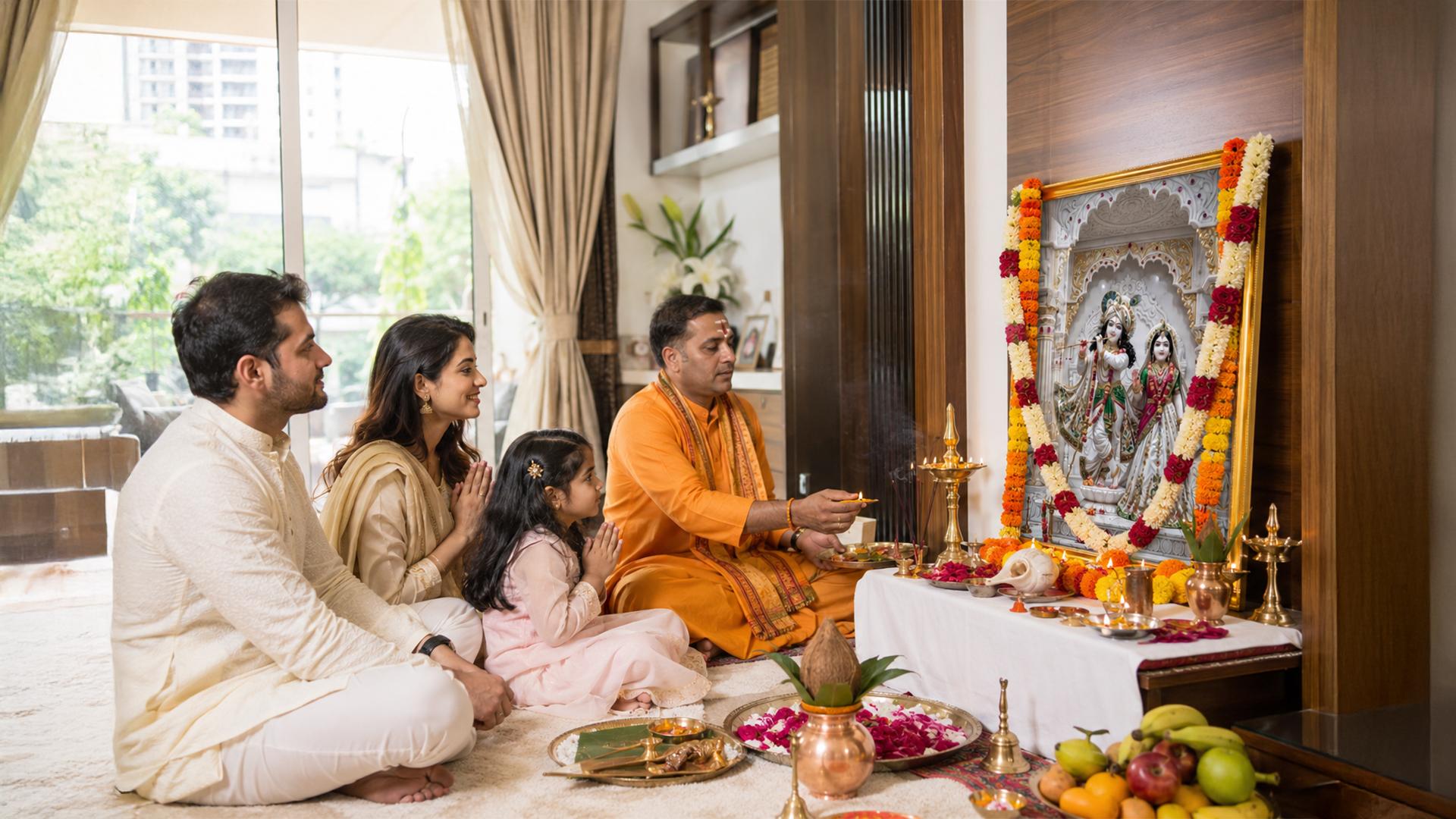
Home/Pooja At Temple/Radha Krishna Puja
Household DeityPerformed by: 1 PanditDuration: 2–4 hours

Radha Krishna Puja

The worship of the divine couple in their Madhurya aspect - the sweetness of the Lord in relationship with his own Hladini Shakti - performed on Janmashtami, Radhashtami, Sharad Purnima, and as the household deity worship of families rooted in the Braj bhakti tradition.

SiddhiStar

Overview

What Is This Puja?

The Bhagavata Purana's tenth Skandha, the most beloved section of all eighteen Puranas, opens with a question to Shuka: what are the deeds of the one whose very name, when heard even accidentally, purifies the listener? The entire Skandha is Shuka's answer, and at its heart is the Raas Panchadhyayi, the five chapters describing the Raas Lila: Krishna's dance with the Gopis on the night of Sharad Purnima. The Raas Lila has been the subject of more commentary, more poetry, and more devotional expression than perhaps any other episode in the Puranic literature. Its significance in the bhakti tradition is not narrative but ontological. The Gopis leave their homes and families in the middle of the night - a violation of every social norm - in response to Krishna's flute call. The Bhagavata interprets this: the flute is the call of the Atman to the Jivatma. The Gopis' response - unhesitating, total, leaving everything behind - is the model of surrender that the bhakti tradition holds as its highest ideal. Radha occupies the central position in the Braj tradition because she is not one of the Gopis but the Gopi - the one in whom Krishna's own bliss-nature is fully reflected. The Brahma Vaivarta Purana's Prakriti Khanda describes her as Krishnapriya, the dearest of all, not because of any quality she possesses separately, but because she is his own Hladini Shakti in the form of a devotee. This is the theological basis for always worshipping Radha alongside Krishna rather than Krishna alone in the Braj tradition.
SiddhiStar Note
"In Vrindavan, the pujaris will not begin the morning Sringara darshan until Radha has been adorned first. Krishna waits. This is not sentiment - it is theology. In the Madhurya tradition, Radha is the gateway. Those who seek Krishna through Radha - through the lens of complete, egoless devotion - access a dimension of the divine that the Aishwarya tradition's formal worship does not reach. The household Radha-Krishna Puja, done with this understanding, is a qualitatively different kind of worsh
Primary Deities
Radha (Vrindavaneshvari, primary alongside Krishna) • Krishna (Nandanandana, Gopala) • Ganesha (first) • Gauri • Varun Dev (via Kalash)

Commonly requested for

  • Janmashtami celebration - the most widely observed annual Radha-Krishna puja in North India
  • Families from Braj-origin backgrounds (Mathura, Vrindavan, Agra, UP) now settled in Delhi NCR
  • Households for whom Radha-Krishna is the primary household deity (Griha Devata)
  • Radhashtami - Radha's annual birth anniversary, eight days after Janmashtami
  • Sharad Purnima - the Raas Lila night; families seeking the Raas Panchadhyayi recitation
  • For couples seeking the blessing of Radha-Krishna's Madhurya relationship in their own marriage
  • Musical families - Radha-Krishna worship is inseparable from music, Sur Sagar and Gita Govinda in the household

Where Does This Puja Come From?

Primary Source
Bhagavata Purana (Skandha 10) - the foundational text for Krishna's life, the Raas Lila, and the Gopis' devotion · Brahma Vaivarta Purana (Prakriti Khanda, Ch. 49) - the primary Purana for Radha's philosophical position as the Hladini Shakti
Supporting Texts
Gita Govinda (Jayadeva, 12th century) · Radha Chalisa (North Indian tradition) · Sur Sagar (Surdas, 16th century, Braj Bhasha) - the most important devotional text for Radha-Krishna worship in the Hindi belt

Ritual Flow

Understanding the sequence helps you participate meaningfully rather than merely observe.

1

Sankalpa

Householder declares intent with gotra, nakshatra, and specific occasion. For Janmashtami, the Sankalpa states the celebration of Krishna's birth and the specific form being worshipped - Bala Gopala (infant Krishna), Nandanandana, or Radha-Krishna in the Yugala (couple) form.

2

Kalash Sthapana and Ganapati Puja

Kalash established. Ganesha worshipped with the Ganapati Atharvashirsha. In the Radha-Krishna tradition, the Ganapati puja specifically uses tulsi - Krishna's leaf - as a connecting offering between Ganesha's worship and the main ceremony.

3

Radha-Krishna Sthapana and Avahana

The Yugala murti (Radha and Krishna together) installed and formally invited. Radha is dressed first - a convention followed in the Braj puja tradition. Fresh tulsi garland placed on the murti. Peacock feather placed at the Radha-Krishna image - Krishna's identifying element.

4

Shodashopachara with Yugala Offerings

Sixteen offerings made to both Radha and Krishna as a couple, not separately. Radha-Krishna's specific offering set: tulsi (primary flower), yellow silk for Krishna, red for Radha, makhan (white butter) and mishri (rock sugar) as Naivedya - the same offering that the Bhagavata describes the Gopis bringing to Krishna.

5

Panchamrit Abhisheka

Five-round abhisheka for the Radha-Krishna murti. In the Janmashtami tradition, the abhisheka at midnight marks the actual moment of Krishna's birth - all family members awake and present.

6

Radha Chalisa and Sur Sagar Passage

The Radha Chalisa recited in full. A selected passage from Surdas' Sur Sagar - the Braj Bhasha devotional poetry of the 16th century - sung or recited by the purohit. The Sur Sagar's Vatsalya Rasa (maternal love for the child Krishna) passages are used for Janmashtami; the Madhurya Rasa passages for Radhashtami and Sharad Purnima.

7

Jhula Ceremony - Janmashtami Specific

A small swing (Jhula) set up for the deity. The Radha-Krishna image swung gently on the Jhula while devotional songs (Jhula songs from the Braj tradition) are sung. This is the Janmashtami ceremony's most intimate and devotional moment.

8

Aarti and Prasad

Aarti with a five-wick lamp. Prasad - makhan mishri (butter and rock sugar), panchamrit, and panjiri - distributed. Panchamrit in which Radha-Krishna was bathed is the primary prasad.

Understanding the sequence helps you participate meaningfully rather than merely observe.

Samagri Required

Every item has a function — this is a functional manifest, not a shopping list.

Radha-Krishna Murti

Yugala (couple) form; metal or stone

Tulsi Leaves (large)

Radha-Krishna's primary offering; never absent

Peacock Feather

Krishna's identifying mark; placed at the murti

Makhan (White Butter)

Krishna's specific Naivedya; offered fresh

Mishri (Rock Sugar)

Naivedya - the sweetness of Madhurya

Yellow Silk

Krishna's colour; Vastra offering

Red Cloth

Radha's colour; her Vastra offering

Panchamrit (5 types)

Abhisheka; also the primary prasad

Panjiri

Roasted wheat flour with dry fruits; Janmashtami prasad

Flute (small)

Placed at the murti; Krishna's symbol; not offered but displayed

Jhula (small swing)

Janmashtami-specific; deity swung at midnight

White Flowers

Radha's flower offering; white jasmine, chameli preferred

Kalash (Copper)

Ceremony anchor

Camphor

Aarti; Agni as witness

SiddhiStar Samagri Policy
All Standard and Premium bookings include the complete samagri kit. Our purohit brings everything - tradition-matched and verified before travel. No sourcing required from your side.

Frequently Asked Questions

For Janmashtami, should we stay awake until midnight or can the puja be done in the morning?
The Janmashtami tradition prescribes midnight worship at the Nishita Kaal - the moment of Krishna's birth. The Bhagavata describes Krishna being born at midnight in the prison of Kansa. The midnight puja, even in an abbreviated form, is the traditional observance. Many households perform a preliminary puja in the evening and the main abhisheka at midnight. If staying awake is not possible for family members, the evening puja is a valid alternative.
We want to fast on Janmashtami. What are the fasting rules?
Is the Radha-Krishna Puja appropriate for households that follow a Shaiva tradition?
Pooja Starting From
Starting from ₹2,500
Final price depends on pandit selection
April 2026
Su
Mo
Tu
We
Th
Fr
Sa
Lineage-Verified pandits
4.9/5 average rating across all bookings
₹2,500per pandit