Home/Pooja At Temple/Gruharambh / New House Construction Puja
Home & PropertyPerformed by: 1 PanditDuration: 2–4 hours

Gruharambh / New House Construction Puja

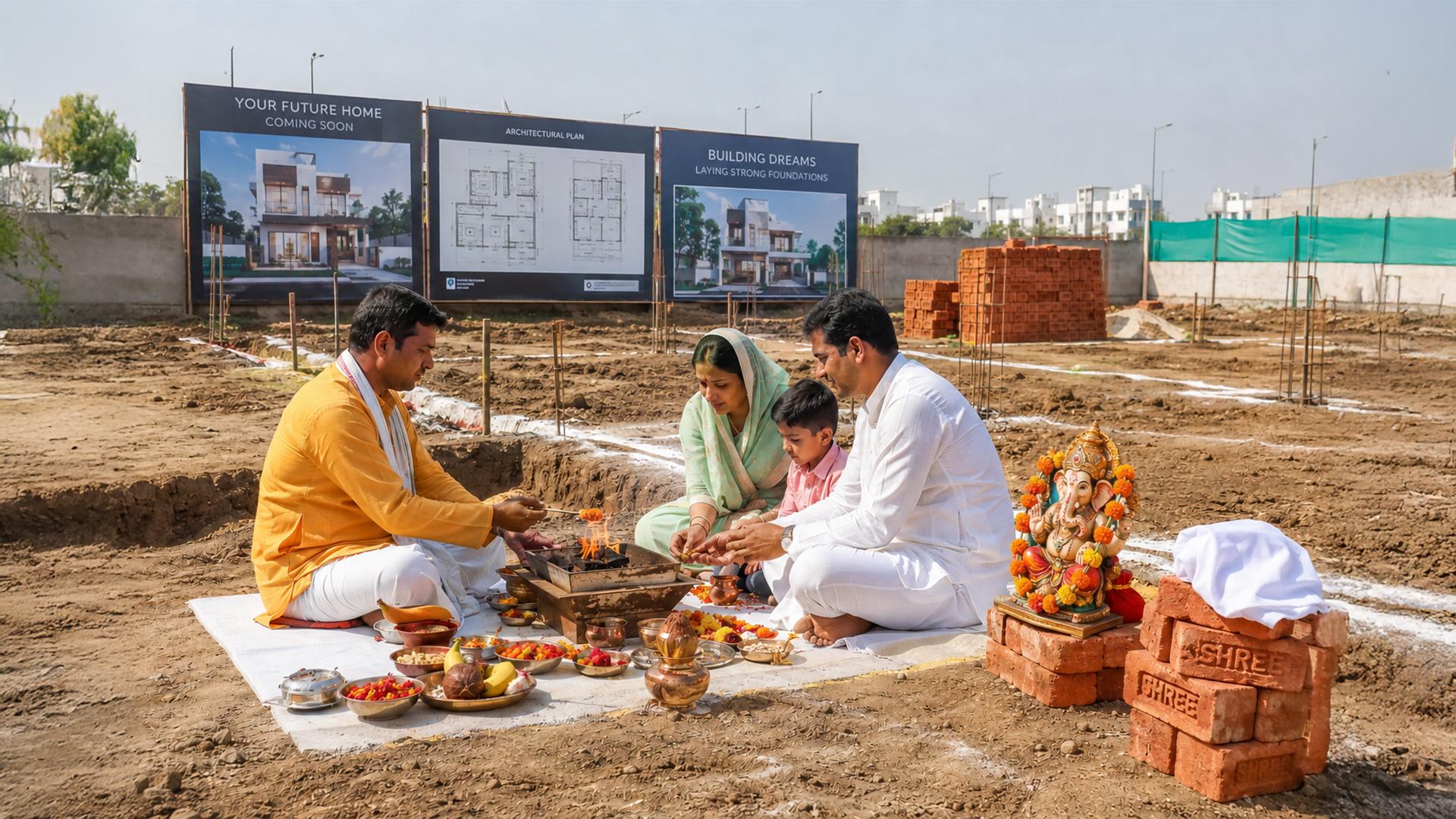
The formal Vedic commencement of house construction - the ceremony that transforms the breaking of ground from a civil act into a sacred one, seeking explicit consent from earth, space, and the cosmic blueprint before the foundation is laid.

SiddhiStar

Overview

What Is This Puja?

In common usage, Bhoomi Puja and Gruharambh are conflated. They are distinct ceremonies serving distinct purposes. Bhoomi Puja is the earth-worship that precedes any ground disturbance - it is an act of seeking permission. Gruharambh is the formal inauguration of construction as a Vedic undertaking - it is the declaration that building has begun under dharmic auspices. The Manasara, one of the principal Vastu Shastra texts, prescribes that construction should not begin on a plot until the Vastu Purusha has been invoked and a Vastu Mandala drawn at the site. The Mandala is not decorative - it is a map of the cosmic energies that will preside over the completed structure for its entire life. Establishing this map correctly before the first brick is laid determines the alignment of the eventual home with the forces that govern human wellbeing. Gruharambh also includes the Shila Sthapana - the ritual placing of the first foundation stone. This stone is not merely the first element of the physical structure; it is the material anchor for all the blessings invoked during the ceremony. In the North Indian tradition, the stone is inscribed with the Swastika, the family gotra, and the puja date before being set in the ground. That inscription is still readable, often, when the building is eventually demolished generations later.
SiddhiStar Note
"The most common error I see is treating Bhoomi Puja and Gruharambh as the same ceremony and performing only one. If a family did Bhoomi Puja at plot acquisition but is now beginning construction months later, Gruharambh must be performed separately. The two ceremonies address different moments in the relationship between owner and earth, and neither substitutes for the other."
Primary Deities
Bhumi Devi (primary) • Vastu Purusha • Ganesha (first) • Gauri-Ganesha • Varun Dev

Commonly requested for

  • Beginning construction of an independently built home on a residential plot
  • Laying the foundation of a commercial or mixed-use building
  • Resuming construction after a legal delay, dispute, or extended gap
  • Families who performed Bhoomi Puja at plot registration and now need the construction commencement ceremony
  • Construction companies and developers seeking Vastu alignment before project commencement

Where Does This Puja Come From?

Primary Source
Paraskara Grihyasutra - construction commencement rites · Manasara Ch. 4 (Vastu Shastra) - foundation-laying procedures
Supporting Texts
Atharva Veda 12.1 - Prithvi Sukta (63 mantras) · Agni Purana Ch. 40–43 · Vishwakarma Purana - construction commencement rites
Vedic Sanction
Prithvi Sukta (Atharva Veda 12.1): the foundational Vedic text on earth reverence; recited in full at Gruharambh in the Paraskara tradition

Ritual Flow

Understanding the sequence helps you participate meaningfully rather than merely observe.

1

Sankalpa and Site Purification

Owner declares intent with full gotra, nakshatra, and construction purpose. The site is purified with cow dung paste, Gangajal, and darbha grass. Cardinal directions of the plot marked with coloured powder.

2

Ganapati Puja

Ganesha worshipped at the site with Shodashopachara. Ganapati Atharvashirsha recited. No construction may begin - even ritually - without Ganesha's formal acknowledgment.

3

Prithvi Sukta Parayana

The complete Prithvi Sukta (Atharva Veda 12.1 - 63 mantras) recited with flowers, rice, and water offered to Bhumi Devi at the exact spot of first excavation. This is the formal seeking of permission from the earth goddess.

4

Vastu Mandala Drawing and Puja

The Vastu Mandala drawn on the ground in prescribed proportions from the Manasara. The 45 fields of the Vastu Purusha's body mapped and worshipped. Each directional devata invoked with specific flowers and grains.

5

Navagraha Sthapana

Nine earthen pots representing the Navagraha placed at the nine prescribed positions on the site. Each pot filled with the corresponding grain, covered with the corresponding cloth colour, worshipped with the Navagraha Stotra.

6

Shila Sthapana - Foundation Stone

The Shila (foundation stone) inscribed with the Swastika, family gotra, and puja date. Wrapped in red cloth. The owner places the stone into the first foundation pit with both hands while mantras are chanted.

7

Homa (if included)

Fire ritual at the site with Shanti mantras. Ahutis offered for the protection of the construction, the workers, and the future residents. Homa ash applied to the foundation stone and site perimeter.

8

Uttarpuja and Prasad

Deities thanked and bid farewell. Purohit blesses the site with Gangajal in all directions. Prasad distributed. Construction may formally begin after the ceremony is complete.

Understanding the sequence helps you participate meaningfully rather than merely observe.

Samagri Required

Every item has a function — this is a functional manifest, not a shopping list.

Shila (Stone or Brick)

Physical foundation anchor - inscribed and ceremonially placed

Red Cloth (2m)

For wrapping the Shila; auspiciousness marking

Vastu Mandala Colours (5)

Coloured powders for Mandala drawing at site

Navagraha Pots (9)

Earthen pots for Navagraha Sthapana

Navagraha Grains (9)

Each specific grain corresponds to one planet

Navagraha Cloths (9)

Each colour specific to one planet

Kalash (Copper)

Varun Dev's seat; energetic anchor for the ceremony

Cow Dung Paste

Site purification before ceremony begins

Gangajal

Site purification and perimeter blessing

Darbha Grass

Vedic purifier; used in all Shuddhi steps

Cow Ghee

Homa medium; atmosphere purification

Havan Samagri

Herbal homa blend for site Homa

Mango Leaves (5)

Kalash mouth; abundance symbol

Panchamrit

Ganapati abhisheka

SiddhiStar Samagri Policy
All Standard and Premium bookings include the complete samagri kit. Our purohit brings everything - tradition-matched and verified before travel. No sourcing required from your side.

Frequently Asked Questions

We already did Bhoomi Puja two months ago. Do we need Gruharambh before starting construction?
Yes. Bhoomi Puja and Gruharambh are separate ceremonies. Bhoomi Puja acknowledged the earth and sought permission. Gruharambh formally begins construction under Vedic auspices - with Vastu Mandala, Navagraha Sthapana, and Shila Sthapana. One does not substitute for the other.
The contractor wants to begin on a Tuesday. Can civil construction start before the puja?
Our plot has an irregular shape. How is the Vastu Mandala drawn for non-rectangular plots?
Pooja Starting From
Starting from ₹2,500
Final price depends on pandit selection
April 2026
Su
Mo
Tu
We
Th
Fr
Sa
Lineage-Verified pandits
4.9/5 average rating across all bookings
₹2,500per pandit