Land Registration / Plot Puja
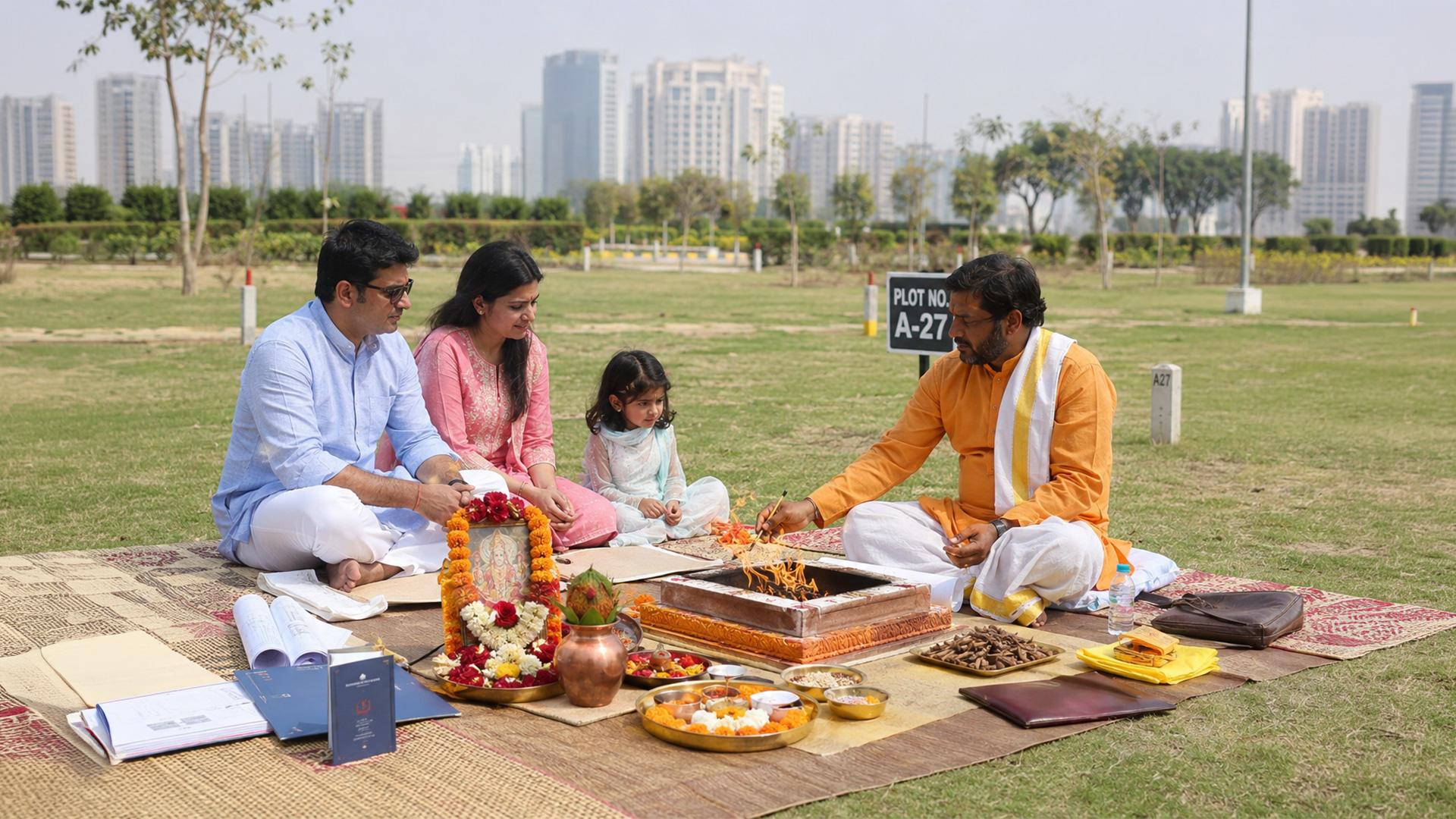
The plot welcomed into the family - Bhumi Devi acknowledged, the boundaries blessed, the land formally claimed in dharmic intent.
Overview
What Is This Puja?
Commonly requested for
- ●On the day of land registration or sale-deed signing
- ●When taking physical possession of a newly purchased plot
- ●On formal mutation of an inherited property
- ●Before any major decision on land use is taken (sale, lease, gifting)
- ●Plots that have been disputed and recently legally resolved
- ●Re-affirming ownership on long-unvisited family land
Ritual Flow
Understanding the sequence helps you participate meaningfully rather than merely observe.
Opening sequence
Pavitrikaran & Achaman
The family's primary member is purified with sacred water and three sips of achaman.
Tilak & Rakshabandhan
Tilak is applied and protective mauli tied on the right wrist of the yajman.
Dik Rakshan
Yellow mustard is offered to the four directions of the plot, securing the boundary.
Samagri Required
Every item has a function - this is a functional manifest, not a shopping list.
Roli (100 gm)
Tilak, sankalp, archan
Moli / Kalawa (2 bundles (gulli))
Wrist, kalash, idol tying
Sindoor (50 gm)
Devi puja, suhag, tilak
Abeer (20 gm)
Archan
Gulal - Lal (20 gm)
Archan
Gulal - Peela (20 gm)
Archan
Abhrak (mica) (20 gm)
Kalash, tantra-pratik
Haldi (powder) (50 gm)
Archan, kalash
Kapur (camphor) (20 gm)
Aarti
Dhoop batti (1 packet)
Dhoop deep
Ruii (cotton) (10 gm)
Wick-making
Itra (5 ml (1 shishi))
Deity offering
Peeli sarso (20 gm)
Puja, kalash
Laung (5 gm)
Naivedya, hawan
Elaichi (chhoti) (5 gm)
Naivedya, hawan
Supari (7 pcs)
Sankalp, kalash
Nariyal (whole) (1 pc)
Kalash sthapana
Panchmewa (50 gm)
Naivedya
Shahad (50 gm shishi)
Panchamrit, naivedya
Sarvaushadhi (10 gm)
Kalash
Janeu / Yajnopavita (5 pcs)
Deity, yajman, sankalp
Important Note
Land Registration / Plot Puja is conducted as Ghar Par Puja only, performed at the plot itself. This puja is distinct from Bhoomi Puja (performed before construction); it is the rite of formal ownership rather than the rite of breaking ground. The Kalash, the chowki, the marker stone or nameplate, the four coconuts, the earthen pot, and the hawan kund (where the Hawan add-on is opted in) are arranged by the family.
Frequently Asked Questions
You Might Also Like

Griha Pravesh Puja
Enter your new home the way the parampara prescribes - Vastu Devta seated, the first lamp lit at the threshold, and the family deity formally established.

Gruharambh / New House Construction Puja
The moment before the first brick - Vastu Devta invited, the mason's tools honoured, the construction blessed before the structure rises.

Factory / Warehouse Opening Puja
A shubh aarambh for your industrial premises - Vishwakarma honoured, Vastu Devta seated, the workspace blessed before the first day of production.