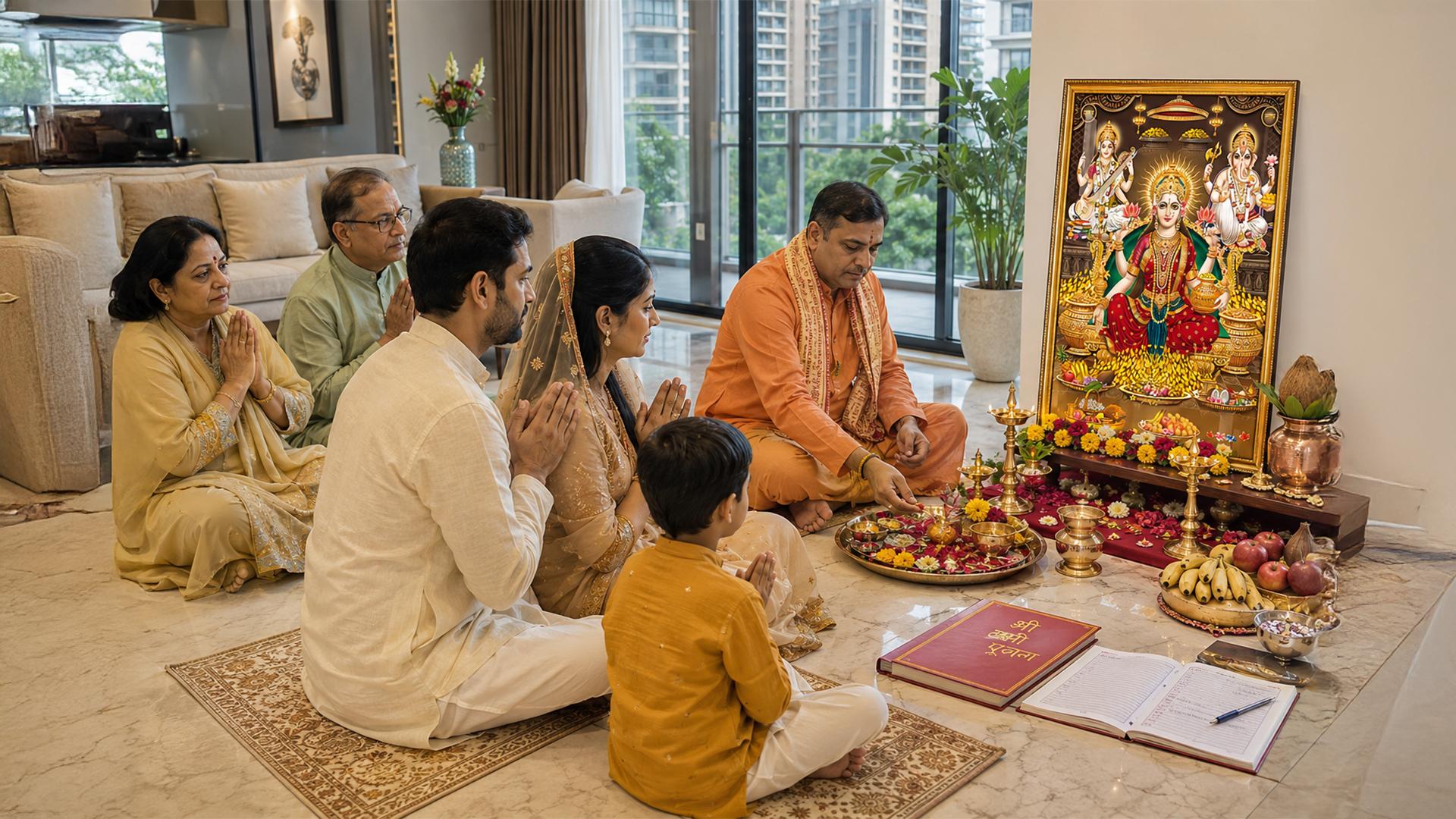
Lakshmi Puja
The household worship of the goddess of abundance - performed on Diwali, Sharad Purnima, and Fridays, centred on the Sri Sukta of the Rigveda, invoking Sri-Lakshmi in her role as the bestower of wealth, auspiciousness, and dharmic prosperity.
Overview
What Is This Puja?
Commonly requested for
- ●Diwali - the primary annual household Lakshmi Puja
- ●New business establishment - invoking Lakshmi as the first deity of the enterprise
- ●Sharad Purnima (Kojagari Purnima) - the night of Lakshmi's visit
- ●Weekly Friday observance for those maintaining the Shukravar Vrat
- ●After financial recovery or significant financial achievement as an act of gratitude
- ●For households experiencing financial difficulty - with specific Sankalpa for reversal
- ●At the time of establishing a new bank account or major investment
Where Does This Puja Come From?
Ritual Flow
Understanding the sequence helps you participate meaningfully rather than merely observe.
Sankalpa
Householder and spouse declare intent. On Diwali, the Sankalpa specifically states: 'I perform this Lakshmi Puja on Kartik Amavasya for the Griha Lakshmi Avahanam (inviting the household Lakshmi) and for [specific intention stated by the family].'
Kalash Sthapana and Gauri-Ganesh Puja
Kalash established. Gauri and Ganesha worshipped together as the prerequisite pair before Lakshmi invocation - Gauri as the witnessing mother, Ganesha as the obstacle-remover. The North Indian tradition insists on both before Lakshmi is invited.
Lakshmi Avahana and Sthapana
Lakshmi formally invited and established in her murti or image. A fresh lotus or marigold placed at the murti. The Avahana mantra from the Sri Sukta tradition recited. A red cloth placed at the murti's base - Lakshmi's preferred colour in the North Indian tradition.
Panchamrit Abhisheka
Five-round abhisheka with milk, curd, honey, ghee, and sugar. Gangajal bath following the five rounds. Vastra (red or yellow silk cloth) offered. The Panchamrit abhisheka is not abbreviated in this puja - it is Lakshmi's primary bath and cannot be replaced with a water sprinkle.
Sri Sukta Recitation - with Flower Offerings
The complete Sri Sukta (15 mantras) recited by the purohit with a fresh flower or akshata offered at each mantra. This is the ceremony's defining section - it distinguishes a proper Lakshmi Puja from a devotional aarti. In the Diwali version, the Sri Sukta is recited twice.
Shodashopachara - Sixteen Offerings
The full sixteen-offering sequence performed: asana, padya, arghya, achamana, snana, vastra, gandha, pushpa (with Sri Sukta), dhupa, dipa, naivedya (sweets - kheer, mishri, panchamrit), tamboola, dakshina, aarti, pradakshina.
Kubera Puja (Diwali version)
On Diwali specifically, Kubera (the lord of wealth) is worshipped alongside Lakshmi. Specific Kubera mantra recited. Coins and a small amount of currency notes placed before the Kubera image or Kubera Yantra. This is the ritual establishment of Lakshmi-Kubera's joint presence in the household's financial life.
Diya Prajwalan and Aarti
On Diwali, the household lamps - ideally clay diyas with mustard oil - are lit in all rooms, on all thresholds, and on the outer boundary of the property. The Lakshmi Aarti performed. Distribution of kheer or sweets as prasad.
Uttarpuja
Lakshmi thanked and bid farewell (for weekly or seasonal pujas). On Diwali, Lakshmi is not formally bid farewell - she is welcomed as a permanent guest who entered the home that night.
Samagri Required
Every item has a function — this is a functional manifest, not a shopping list.
Lakshmi Murti
Silver or gold; lotus-seated form; new murti for Diwali puja is traditional
Kalash (Copper)
Ceremony anchor; Varun Dev's seat
Red Cloth
Lakshmi's colour in North Indian tradition; used as asana and offering
Lotus Flowers
Lakshmi's vehicle and primary offering
Panchamrit (5 types)
Abhisheka sequence: milk, curd, honey, ghee, sugar
Sri Sukta Flowers
One fresh flower or akshata per mantra for 15 mantras
Kheer / Mishri
Naivedya - Lakshmi's preferred sweet offering
Gangajal
Post-Panchamrit bath
Clay Diyas (21+)
Diwali-specific: lit in all rooms and at the threshold
Mustard Oil
Traditional Diwali diya oil - not ghee for outdoor diyas
Kumkum
Applied to Lakshmi's feet; threshold marking
Akshata
Sixteen-offerings component
Coins (11 or 21)
Kubera Puja component on Diwali; placed before deity
Currency Notes
Placed before Lakshmi and Kubera on Diwali for the financial-year blessing
Frequently Asked Questions
You Might Also Like
Radha Krishna Puja
The worship of the divine couple in their Madhurya aspect - the sweetness of the Lord in relationship with his own Hladini Shakti - performed on Janmashtami, Radhashtami, Sharad Purnima, and as the household deity worship of families rooted in the Braj bhakti tradition.
Ram Darbar Puja
The worship of the complete divine court of Rama - Rama, Sita, Lakshmana, and Hanuman together - honouring not one deity but the entire field of dharmic relationships they embody, invoked for family harmony, righteous household life, and the blessing of the ideal that every relationship aspires to.
Mahalakshmi Puja
The complete upasana of Lakshmi in her cosmic Mahalakshmi form - worshipping the goddess across her eight aspects of abundance through the Ashtalakshmi framework, the Mahalakshmi Ashtakam, and an extended offering sequence.