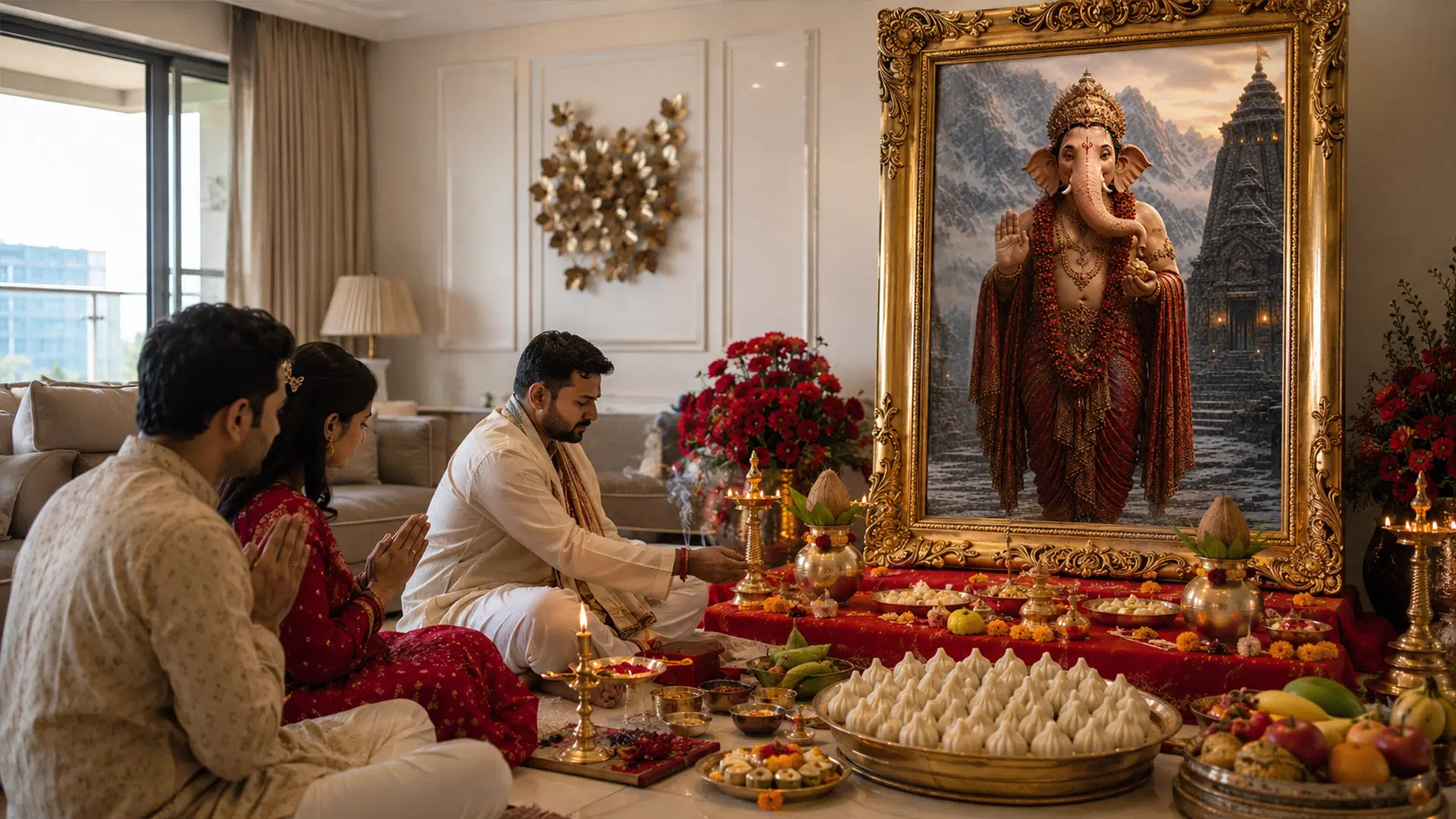
Maha Ganpati Puja
The elaborate upasana of Ganesha in his Maha Ganapati form - the sixteen-armed supreme aspect described in the Mudgala Purana - including Yantra worship, Sahasranama recitation, and Homa, performed for specific and significant intentions.
Overview
What Is This Puja?
Commonly requested for
- ●Large business ventures or commercial partnerships being formally inaugurated
- ●Families returning to India after extended periods abroad, re-establishing ritual connection
- ●Before major legal proceedings where an obstacle to justice is being experienced
- ●Prolonged infertility - Maha Ganapati with Santan Gopal Sankalpa
- ●Annual Ganesh Chaturthi celebration for families seeking the most complete vidhi
- ●Business owners who have experienced significant loss and are beginning again
Where Does This Puja Come From?
Ritual Flow
Understanding the sequence helps you participate meaningfully rather than merely observe.
Sankalpa - Extended
The Sankalpa for Maha Ganpati Puja is more detailed than the standard invocation. Gotra, nakshatra, specific occasion, specific intention, and the specific form of Maha Ganapati being invoked (Siddhi Ganapati, Lakshmi Ganapati, or Maha Ganapati in the universal sense) are all stated.
Kalash Sthapana and Punyahavachana
A large copper kalash established. Complete Punyahavachana performed - space purification with Varun mantras, darbha grass, and Gangajal. The Punyahavachana is not abbreviated in this puja - the ceremony's extended duration requires full spatial consecration.
Maha Ganapati Avahana
Maha Ganapati invoked into both the murti and the Yantra. The Yantra is first placed on a bed of rice flour and worshipped with Gandhapushpa. Maha Ganapati's sixteen arms and their respective implements are individually acknowledged through specific mantras from the Mudgala Purana.
Shodashopacharas - Extended Offerings
The sixteen offerings are performed with enhanced quantities and more elaborate mantras than the standard Ganesh Puja. The Panchamrit abhisheka for Maha Ganapati uses five separate abhisheka sequences rather than one.
Ganapati Atharvashirsha - Three Repetitions
The Atharvashirsha recited three times consecutively. In the Maha Ganpati tradition, three repetitions constitute one complete Parikrama - a full circumambulation of the deity's philosophical territory.
Ganesha Sahasranama
The complete Ganesha Sahasranama (1000 names) from the Ganesha Purana recited with a flower or akshata offered at each name. This takes 45–60 minutes and is the ceremony's most extended and concentrated component.
Maha Ganapati Yantra Puja - Specific Upachara
The Yantra worshipped with its specific set of offerings distinct from the murti worship - specific colours, fragrances, and geometric offerings prescribed in the Tantric Ganesha tradition and adapted for Smartha practice.
Homa - Ganapati Havan
Fire ritual with 108 Ahutis. The Ganesha Gayatri (Om Ekadantaya Vidmahe Vakratundaya Dhimahi / Tanno Danti Prachodayat) recited with each Ahuti. Homa ash applied to the Yantra and to the forehead of all family members present.
Uttarpuja and Prasad
Aarti with a five-wick lamp. Extended Mangalacharana. Purohit gives specific post-puja instructions for maintaining the energy of the Maha Ganapati Yantra in the home. Prasad - modak, coconut, and fruit - distributed.
Samagri Required
Every item has a function — this is a functional manifest, not a shopping list.
Maha Ganapati Yantra
Copper or silver; the ceremony's most critical material object
Ganesha Murti
Large murti - clay or metal; not temporary for this ceremony
Durva Grass (large qty)
108 bundles of three-blade durva; used in Sahasranama offerings
Modak (108)
Naivedya offering in the elaborate count for Maha Ganpati
Red Flowers (large qty)
Hibiscus, red marigold; Ganesha's primary offering colour
Panchamrit (5 types)
Full separate sequences for 5-round abhisheka
Cow Ghee (500g)
Homa medium; 108-Ahuti Homa requires significant quantity
Havan Samagri
Herbal blend for Ganesha Homa
Kalash (Copper, large)
Full Punyahavachana requires large kalash
Mango Leaves (21)
Extended kalash setup for full ceremony
Sandalwood Paste
Extended Gandha offerings for both murti and Yantra
Tamboola (Paan)
Extended offering set for full Shodashopachara
Camphor (large)
Extended Aarti for full ceremony duration
Supari (11)
Deity proxy for extended Sankalpa
Frequently Asked Questions
You Might Also Like
Radha Krishna Puja
The worship of the divine couple in their Madhurya aspect - the sweetness of the Lord in relationship with his own Hladini Shakti - performed on Janmashtami, Radhashtami, Sharad Purnima, and as the household deity worship of families rooted in the Braj bhakti tradition.
Ram Darbar Puja
The worship of the complete divine court of Rama - Rama, Sita, Lakshmana, and Hanuman together - honouring not one deity but the entire field of dharmic relationships they embody, invoked for family harmony, righteous household life, and the blessing of the ideal that every relationship aspires to.
Mahalakshmi Puja
The complete upasana of Lakshmi in her cosmic Mahalakshmi form - worshipping the goddess across her eight aspects of abundance through the Ashtalakshmi framework, the Mahalakshmi Ashtakam, and an extended offering sequence.