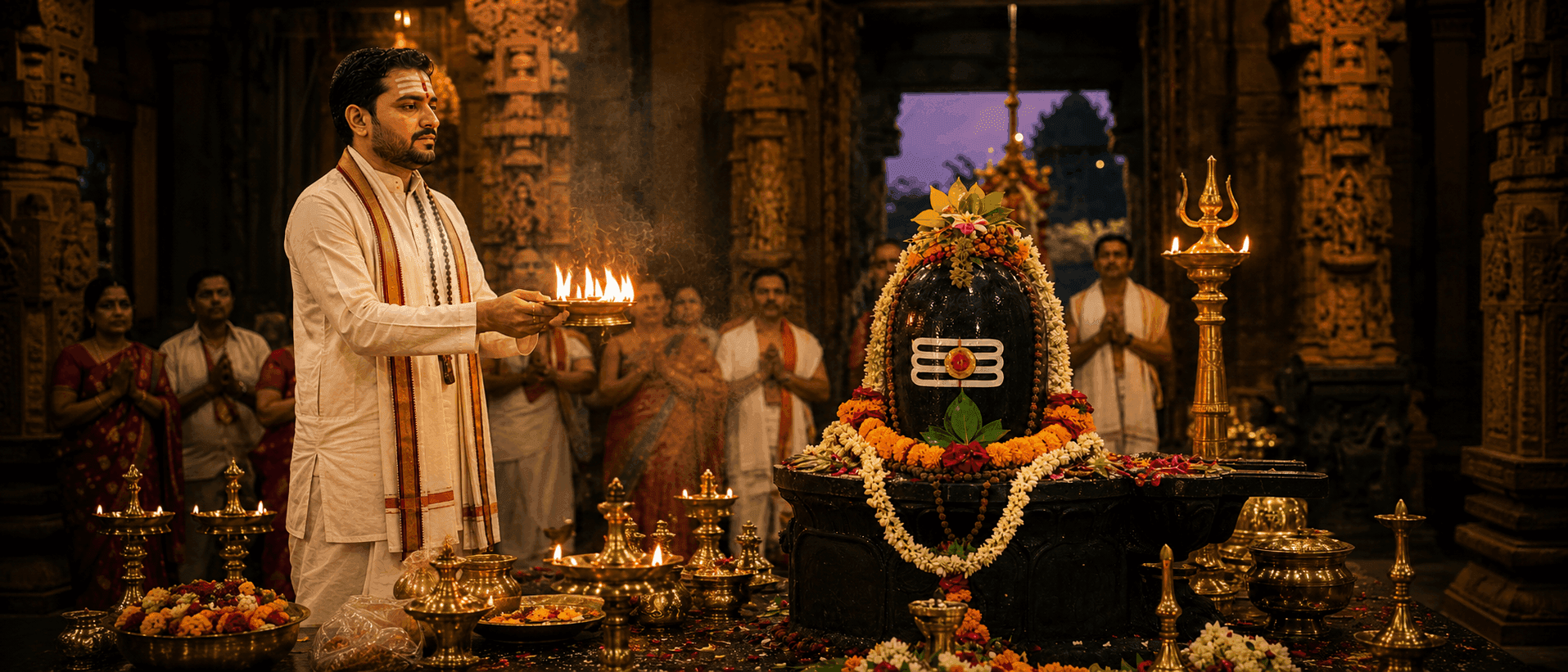
Shiva and Parvati honoured in the twilight kaal - the household's evening puja extended into a full Pradosh observance with bilva patra and the prescribed shringar.
Overview
What Is This Puja?
Pradosh Puja is the dedicated Shiva-Parvati rite performed during Pradosh kaal - the auspicious evening twilight just before sunset, when Shiva ji and Parvati ji are believed to be in their most accessible mood. Distinct from a standalone Shiva Puja, Pradosh Puja extends the household's evening worship into a complete 2.5-hour rite incorporating Shiva-Parvati pujan together, formal abhishek of the Shivling with the prescribed five substances, bilva patra archan, and Pradosh-specific Shanti mantras.
The puja is widely performed on Pradosh tithis (the thirteenth tithi of every fortnight), with Soma Pradosh (Monday Pradosh) and Shani Pradosh (Saturday Pradosh) being especially auspicious. The ritual moves through purification, sankalp, invocation of Ganesh ji, the central pujan of Shiva-Parvati together with full vidhi-vidhan, the Panchamrit abhishek, the offering of bilva patra and Pradosh-specific naivedya, and the closing aarti. At SiddhiStar, the puja is performed at home, or as an Online Puja with the pandit performing live from Narwar Dham while the family joins live from home. Your gotra and Kul Devata are recorded at booking. The base puja takes approximately 2.5 hours, with Hawan offered as an optional 30-minute add-on at the time of booking.
SiddhiStar Note
“In the parampara, Pradosh kaal is the twilight window when Shiva ji and Parvati ji are said to dance together at Kailash, and the household that observes Pradosh is said to receive their joint grace. The ideal performance window, between approximately 4:30pm and 7:00pm depending on the season, is when the household's lamps are first lit, when the day's work is closing, and when the family naturally returns to the pooja ka sthan. Pradosh Puja extends that household instinct into a formal rite.”
Primary Deities
Shiva (Mahadeva) • Parvati (Gauri) • Ganesha (first, as Shiva's son) • Varun Dev (via Kalash)
Commonly requested for
●On Pradosh tithi (thirteenth tithi of every fortnight) as the recurring observance
●During Sawan month, when every Pradosh is especially auspicious
●On Maha Shivaratri evening as part of the night-long observance
●Before significant household decisions during a Pradosh tithi
●As an annual vaarshik puja for families devoted to Shiva-Parvati worship
Ritual Flow
Understanding the sequence helps you participate meaningfully rather than merely observe.
Opening sequence
1
Pavitrikaran & Achaman
The family's primary member is purified with sacred water and three sips of achaman before the rite.
2
Tilak & Rakshabandhan
Tilak (chandan-bhasma) is applied to the forehead and protective mauli tied on the right wrist of the yajman.
3
Dik Rakshan
Yellow mustard is offered to the four directions to secure the puja space.
Understanding the sequence helps you participate meaningfully rather than merely observe. The Panchamrit Abhishek and the 108 bilva patra archan are the elements unique to the Pradosh rite that distinguish it from a standalone Shiva Puja.
Samagri Required
Every item has a function - this is a functional manifest, not a shopping list.
Roli (100 gm)
Tilak, sankalp, archan
Moli / Kalawa (2 bundles (gulli))
Wrist, kalash, idol tying
Sindoor (50 gm)
Devi puja, suhag, tilak
Abeer (20 gm)
Archan
Gulal - Lal (20 gm)
Archan
Gulal - Peela (20 gm)
Archan
Abhrak (mica) (20 gm)
Kalash, tantra-pratik
Haldi (powder) (50 gm)
Archan, kalash
Kapur (camphor) (20 gm)
Aarti
Dhoop batti (1 packet)
Dhoop deep
Ruii (cotton) (10 gm)
Wick-making
Itra (5 ml (1 shishi))
Deity offering
Peeli sarso (20 gm)
Puja, kalash
Laung (5 gm)
Naivedya, hawan
Elaichi (chhoti) (5 gm)
Naivedya, hawan
Supari (7 pcs)
Sankalp, kalash
Nariyal (whole) (1 pc)
Kalash sthapana
Panchmewa (50 gm)
Naivedya
Shahad (50 gm shishi)
Panchamrit, naivedya
Sarvaushadhi (10 gm)
Kalash
Janeu / Yajnopavita (5 pcs)
Deity, yajman, sankalp
SiddhiStar Samagri Policy
The SiddhiStar Anushthan Samagri required for the puja is included in the puja price. The family may choose to receive the samagri at home before the puja date, or arrange the required items themselves from a local kirana store or home delivery app. Either option is honoured equally. The Anushthan Samagri is provided for convenience and standardisation, and is not a separate charge or a ritual necessity.
Hawan Samagri is separate from the Anushthan Samagri and is available as an optional add-on at an additional charge. If the family opts for a Hawan as part of the puja, the applicable Hawan Samagri will be included and charged separately.
Important Note
The base puja is 2.5 hours (3 hours with Hawan add-on). The puja can be booked at any time of day, but per the parampara, Pradosh kaal, the evening twilight window of approximately 4:30pm to 7:00pm (varying by season), is the most auspicious window. Families booking outside this window still receive the full Pradosh vidhi; the timing is a preference, not a strict requirement.