Home/Pooja At Temple/Rudrabhishek
Household DeityPerformed by: 1 PanditDuration: 2–8 hours

Rudrabhishek

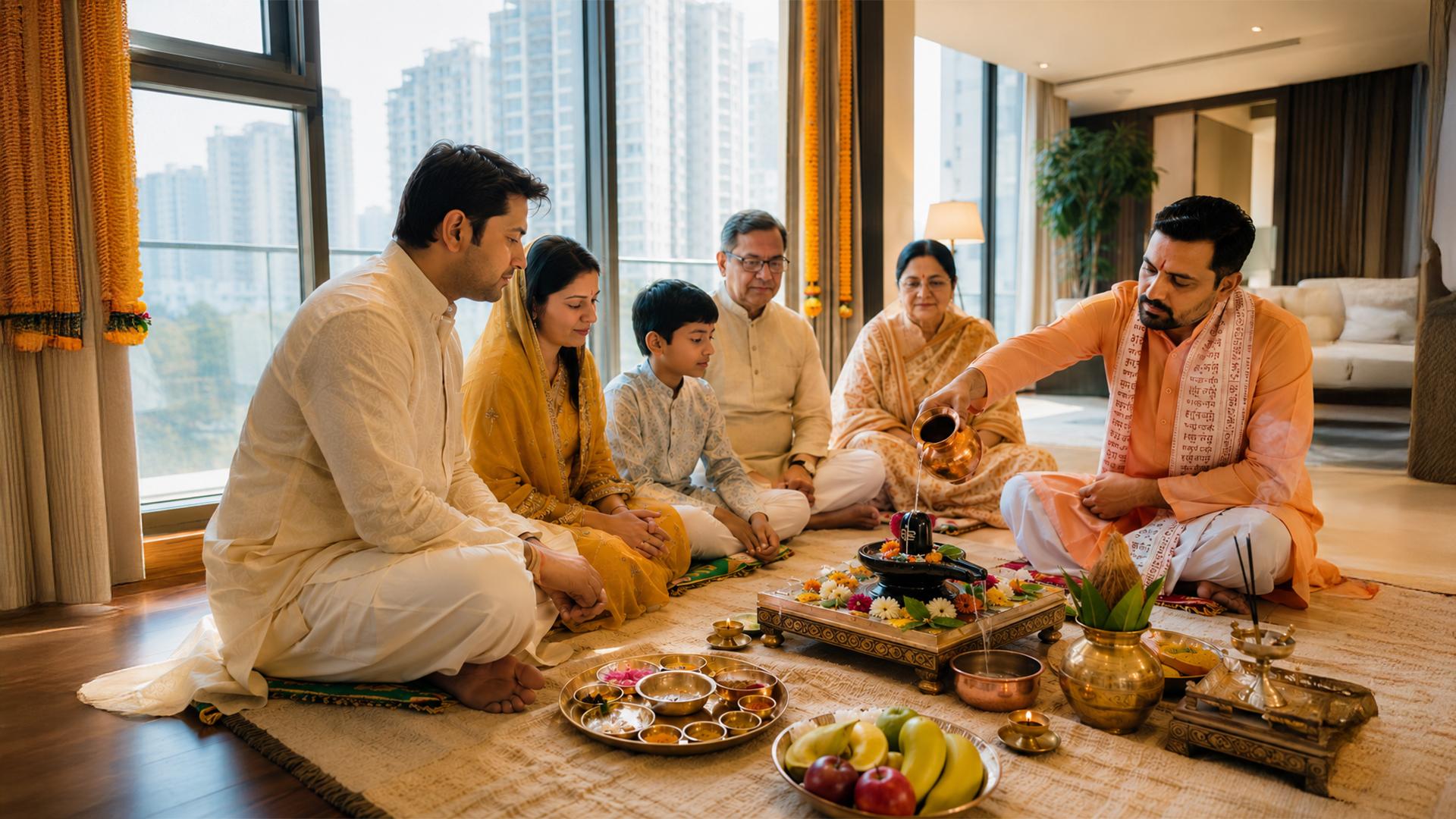
The most sacred liquid offering to Lord Shiva - a continuous abhisheka (bathing) with specific sacred substances, chanted with the Shri Rudra and Chamakam from the Krishna Yajurveda.
Rudrabhishek

Overview

What Is This Puja?

Rudrabhishek is one of the oldest continuous ritual traditions in the world. The Shri Rudra - the hymn that forms the core of the ceremony - is among the most ancient texts of the Krishna Yajurveda, predating most of the Puranic literature. It addresses Rudra in 11 anuvaka (sections), each acknowledging a different aspect of his cosmic presence and asking for his grace. The Abhisheka - the bathing of the Shivalinga with sacred substances - is the physical expression of that asking. Each substance offered has a specific effect: milk for longevity, curd for victory, honey for eloquence, ghee for wisdom, sugarcane juice for happiness, Panchamrit for all benefits. The offering transforms the liquid before it reaches the linga. The difference between a Rudrabhishek and a simple Shiva Puja is the Vedic text: in Rudrabhishek, the entire Shri Rudra is recited with correct Vedic accent (svara) during the abhisheka. This requires a purohit trained specifically in Yajurveda recitation - not simply in puja performance.
SiddhiStar Note
"The Shri Rudra has three levels of meaning: the outer (natural phenomena and their deities), the inner (aspects of the human body and mind), and the transcendent (descriptions of Shiva's cosmic nature). A purohit who understands all three levels recites differently than one who recites only the words. You can hear the difference."
Primary Deities
Shiva as Rudra (primary) • Ganesha (first) • Parvati/Gauri (accompaniment)

Commonly requested for

  • Shravan Maas (July-August) monthly or weekly observance
  • Shivratri household puja
  • Health restoration for a family member
  • Relief from Shani dosha or Rahu-Ketu afflictions
  • Specific sankalp - completing a vow made to Shiva
  • Before major surgery or medical intervention

Where Does This Puja Come From?

Primary Source
Krishna Yajurveda - Taittiriya Samhita, Ch. 4 (Shri Rudra) and Ch. 4.7 (Namakam) + Ch. 4.5 (Chamakam)
Supporting Texts
Shiva Purana - Abhisheka Vidhi · Skanda Purana - Shravan Maas Mahatmya (for Shravan timing)

Ritual Flow

Understanding the sequence helps you participate meaningfully rather than merely observe.

1

Shivalinga Shuddhi

The Shivalinga (home murti or specifically provided copper linga) is purified with Gangajal and Panchamrit before the ceremony begins.

2

Sankalpa

Householder declares gotra, specific intention (health, protection, general welfare), and the number of Rudra recitation cycles.

3

Ganapati Puja

Ganesha invoked - the first step before any Shiva ceremony.

4

Kalash Sthapana

Sacred Kalash established. The abhisheka substances are arranged in order of use.

5

Shri Rudra Recitation - Namakam (11 Anuvakas)

The first part of the Shri Rudra - Namakam - recited with full Vedic svara accent while the purohit performs continuous abhisheka. This takes approximately 45 minutes per cycle.

6

Chamakam (11 Anuvakas)

The second part of the Shri Rudra - Chamakam - recited. Chamakam is the asking: each of the 11 sections lists blessings requested from Rudra. This is the devotional component.

7

Abhisheka Substances Sequence

Performed simultaneously with recitation - Water, Milk, Curd, Honey, Sugarcane Juice, Ghee, Panchamrit, Coconut Water, Gangajal - each has its prescribed mantra and sequence.

8

Bilvashtakam & Bilva Puja

108 Bilva (bael) leaves offered to the Shivalinga with the Bilvashtakam recitation. Bilva is Shiva's most sacred leaf.

9

Rudra Aarti

Closing aarti and prasad distribution. Vibhuti (sacred ash) distributed as Shiva's prasad.

Understanding the sequence helps you participate meaningfully rather than merely observe.

Samagri Required

Every item has a function — this is a functional manifest, not a shopping list.

Shivalinga (Copper, min 3 inches)

The aniconic form of Shiva - the object of abhisheka

Milk (Full cream, 1–2 liters)

Primary abhisheka substance - for longevity

Curd (250ml)

Abhisheka - for victory

Honey (100ml)

Abhisheka - for eloquence and sweetness in relationships

Sugarcane Juice (500ml)

Abhisheka - for happiness

Gangajal (Sacred Ganga water)

Final abhisheka - purification

Bilva Leaves (108 minimum)

Shiva's most sacred leaf - offered with Bilvashtakam

White Flowers (Dhatura, White Lotus)

Shiva's preferred flowers - white and blue

Bhasma / Vibhuti

Sacred ash - offered to Shiva and distributed as prasad

Rudraksha Mala

Used by purohit during recitation and as blessing for the devotee

Cow Ghee

Abhisheka and lamp fuel

SiddhiStar Samagri Policy
All Standard and Premium bookings include the complete samagri kit. Our purohit brings everything - tradition-matched and verified before travel. No sourcing required from your side.

Frequently Asked Questions

What is the difference between Rudrabhishek and a regular Shiva Puja?
In a regular Shiva Puja, the deity is worshipped with offerings and mantras from the Puranic tradition. In Rudrabhishek, the Shri Rudra from the Krishna Yajurveda is recited with Vedic accent during the continuous abhisheka. The Vedic recitation is significantly more powerful - but it also requires a specifically trained purohit.
Is Rudrabhishek performed only during Shravan?
What is the benefit of Laghurudra over single Rudrabhishek?
Pooja Starting From
Starting from ₹2,500
Final price depends on pandit selection
April 2026
Su
Mo
Tu
We
Th
Fr
Sa
Lineage-Verified pandits
4.9/5 average rating across all bookings
₹2,500per pandit